
Every week, I field calls from distributors and OEM purchasing managers who’ve read three articles online and walked away more confused than when they started. The question sounds simple: Can a laser cutter cut metal? But the moment you need to spec a machine for a production line — or resell one to a fabrication customer — that question splits into twenty harder ones.
Wrong answers here don’t just cost time. They cost machines, contracts, and margin.
So let me give you the answer a manufacturer actually gives. Not a sales answer. An engineering answer.
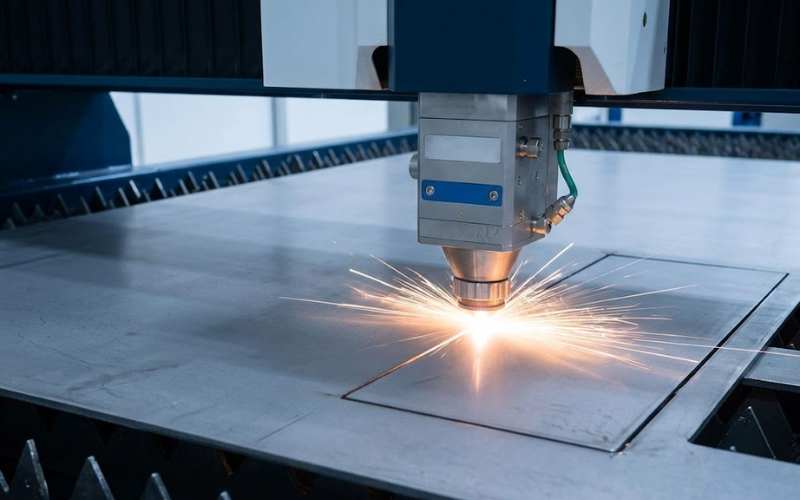
The Short Answer — and Why It’s Not Enough
Yes, a laser cutter can cut metal. But “cutting” means three different things in practice, and confusing them is the most expensive mistake I see buyers make.
The three levels of laser-metal interaction are:
- Surface marking — oxidizes or discolors the surface without removing material. Often mistaken for “cutting” by hobbyist-grade diode machine sellers.
- Engraving — removes shallow layers of material. Creates texture or depth but does not cut through.
- Full cut-through — severs the material completely along a programmed path. This is what industrial production requires.
Only a properly configured, sufficiently powered laser system achieves full cut-through on metal. The laser type matters enormously. The wattage matters—the assist gas matters. Every one of these variables interacts with the others, and optimizing one while ignoring the rest produces poor edge quality, excessive heat-affected zones, or outright machine damage.
I’ve seen a purchasing manager sign off on a 2kW CO2 system for a customer cutting 4mm stainless steel. The machine arrived. It couldn’t do the job. The distributor ate the return cost. That’s a $40,000 lesson that a ten-minute specification conversation would have prevented.
For a deeper breakdown of which materials pair with which laser systems, see our Laser Cutting Materials Guide — it covers absorption rates, melting thresholds, and safety classifications that purchasing teams rarely find consolidated in one place.
Two Laser Technologies, Completely Different Outcomes
This is the decision that determines everything downstream. Get it wrong at the specification stage, and no amount of parameter tuning can recover it.
Fiber Laser: The Metal Specialist
A fiber laser generates its beam through a rare-earth-doped fiber-optic cable — typically ytterbium — producing a wavelength of approximately 1,064 nanometers. That wavelength is absorbed by metal surfaces at a dramatically higher rate than CO2’s output. The U.S. Department of Energy confirms that fiber lasers reach electrical-to-optical efficiencies above 30% — significantly higher than older laser technologies and a key reason operating costs are lower per part.
In our production facility in Suzhou, I’ve run fiber systems from 1kW through 20kW on carbon steel, stainless, aluminum, and copper. The absorption advantage is not marginal. It is structural. A 3kW fiber laser cuts 1mm stainless steel at speeds exceeding 35 m/min. A CO2 system at equivalent power on the same material runs at a fraction of that rate — and the edge quality degrades visibly past 2mm thickness.
Fiber lasers also carry lower long-term operating costs. No mirrors to align. No gas-mix laser tube to replace. The beam path runs through the fiber itself. Fewer consumable optical components. Less downtime between service intervals. For an OEM running two or three shifts, that uptime differential translates directly into throughput and scheduling reliability.
CO2 Laser: Useful, But Limited on Metal
CO2 systems use a gas mixture — primarily carbon dioxide, nitrogen, and helium — to produce a beam at 10,600 nanometers. That wavelength absorbs efficiently into organic materials: wood, acrylic, fabric, leather, PET film. Metal, however, reflects much of it.
A high-power CO2 system can cut thin metal sheets — we’re talking 1–2mm mild steel under specific conditions. But it cannot match fiber’s speed, edge quality, or operational cost on any metal above that threshold. I’ve tested both side by side on 3mm stainless. The CO2 result needed secondary deburring. The fiber result went straight to assembly. That’s the practical difference.
For distributors whose customers work in mixed-material environments — signage, furniture, packaging — a CO2 system remains a valid product line. For anyone whose end customers fabricate metal parts professionally, it is the wrong tool. Selling it into that application damages your reputation faster than any competitor could.
| Specification | Fiber Laser | CO2 Laser |
|---|---|---|
| Wavelength | ~1,064 nm | ~10,600 nm |
| Metal absorption rate | High | Low |
| Power range (industrial) | 1kW – 60kW | 100W – 6kW |
| Electrical efficiency | >30% | ~10–15% |
| Best for metals | Yes — all thicknesses | Thin sheets only (<2mm) |
| Best for non-metals | Limited | Yes — acrylic, fabric, wood |
| Maintenance cycle | Low (no mirror alignment) | Higher (optical alignment required) |
| Typical wall-plug power cost | Lower per part on metal | Higher per part on metal |

For a full side-by-side comparison structured around production environment and material type, read our CO2 vs Fiber Laser Cutting Machine guide — written specifically for distributors evaluating which product line to carry.
What Metals Can a Laser Cutter Actually Cut?
Most of them — with the right system. But each metal has properties that change how you configure the machine, which assist the gas you use, and what edge finish to expect. This is where I see the most specification errors from distributors who inherit a customer requirement without fully understanding the material.
Ferrous Metals
Carbon steel is the workhorse of fiber laser cutting. It cuts cleanly across a wide thickness range, responds well to oxygen assist gas on thick plates, and produces consistent edges at production speeds. In our factory, a 6kW fiber system running oxygen assist on 10mm carbon steel produces edges that go directly to welding without grinding. That’s the standard a production customer expects.
The Manufacturing Technology Association lists carbon steel as the most common fiber laser cutting material in industrial fabrication — and in our shipment data, it represents the majority of material types our customers run on the machines we supply.
Stainless steel requires more attention. Its corrosion resistance is a benefit in the end product but creates complications during cutting — specifically, a tendency to oxidize at the cut edge if oxygen is used as assist gas. Nitrogen assist is the standard for stainless. The edge comes off the machine bright and clean, requiring no secondary finishing before welding or surface treatment.
Mild steel behaves similarly to carbon steel. Most structural fabrication work runs on mild steel at 3–12mm. A 6kW fiber laser handles this range at production-viable speeds with consistent quality across a full shift.
Non-Ferrous Metals
Aluminum is where I see the most configuration errors in the field. High thermal conductivity means heat dissipates fast — which can push the effective cutting zone out of optimal focus before the cut completes. We’ve had customers call in with poor aluminum cut quality, and in every case, the root cause was either insufficient power density for the thickness or incorrect assist gas pressure. High-power fiber lasers with nitrogen or compressed air assist manage aluminum well. But parameters need dialing in tightly, and that work needs to happen before the machine goes into production — not after the first batch of rejected parts.
Aluminum’s reflectivity is also a genuine risk. Back-reflection events can damage the cutting head on underpowered or improperly configured machines. Any fiber laser system destined for aluminum cutting must include back-reflection protection as standard — not an option.
Copper and brass are highly reflective and thermally conductive — a difficult combination. Standard fiber laser configurations can damage the cutting head on these materials if power settings aren’t carefully controlled. High-power systems at 6kW and above, with argon or nitrogen assist, handle copper and brass reliably, as documented in Fractory’s industrial materials guide. For OEM buyers whose customers cut copper regularly — electrical components, heat exchangers — confirm that the machine specification explicitly includes back-reflection protection before the purchase order is signed.
Titanium is used in aerospace and medical device applications. It cuts with fiber lasers using argon assist. Nitrogen causes nitration of the cut surface, which alters the material’s properties in a way that fails inspection in precision manufacturing. If your customer cuts titanium, that needs to be in the spec brief from day one.
Materials That Must Never Enter a Laser Cutting Environment
Some materials are dangerous in a laser cutting system regardless of machine type. This is not an edge case — it is a liability issue for distributors who recommend machines without addressing it.
| Material | Why It’s Dangerous |
|---|---|
| PVC / Vinyl | Releases hydrogen chloride gas — destroys machine optics and poses a serious operator health risk |
| Galvanized steel | Zinc oxide fumes are acutely toxic; they require exceptional fume extraction and operator protection |
| Polycarbonate | Melts rather than cuts; produces sticky residue that contaminates optics and ruins the cut head |
| Beryllium copper | Beryllium oxide dust is carcinogenic — requires specialized industrial controls and disposal protocols |
| ABS plastic | Melts heavily, produces corrosive residue, and leaves contamination inside the machine enclosure |
The CDC / NIOSH laser hazard guidelines classify laser-generated air contaminants from certain materials as occupational health hazards with defined exposure limits. For distributors supplying machines into markets with OSHA (US), CE (EU), or equivalent safety compliance requirements, this is a specification conversation that must happen before the machine ships — not after an incident report.
How Thick Can a Laser Cutter Cut Metal? The Power-Thickness Matrix
“Maximum thickness” is a marketing number. The production-viable thickness — where edge quality, speed, and cost remain acceptable for a commercial production run — is always lower.
I’ve seen 3kW machines advertised as cutting 20mm carbon steel. Technically true. At 0.6 m/min, with rough edges and a heat-affected zone that would fail any precision inspection. No production manager schedules that. Here is what the numbers look like across the industrial wattage bands, based on real benchmark data aligned with Messer Cutting Systems specifications and Senfeng’s published power comparison research:
| Laser Power | Carbon Steel | Stainless Steel | Aluminum | Typical Application |
|---|---|---|---|---|
| 1kW – 2kW | Up to 6mm | Up to 4mm | Up to 3mm | Electronics casings, sheet metal enclosures |
| 3kW | Up to 12mm | Up to 8mm | Up to 6mm | HVAC, elevator panels, kitchen equipment |
| 6kW | Up to 20mm | Up to 16mm | Up to 12mm | Structural fabrication, automotive parts |
| 10kW | Up to 30mm | Up to 25mm | Up to 20mm | Heavy fabrication, industrial machinery frames |
| 15kW – 20kW | Up to 50mm | Up to 35mm | Up to 30mm | Shipbuilding, offshore structures, heavy plate |
All figures represent production-viable thickness — not theoretical maximum. Edge quality at these thicknesses is suitable for direct-to-assembly or direct-to-welding workflows without secondary grinding.
Assist Gas Is Not Optional — It’s a Profit Variable
Every industrial fiber laser cut requires an assist gas. The gas does two things simultaneously: it evacuates molten material from the kerf, and it controls the chemical environment at the cut surface. Get this wrong, and you get oxidized edges, slow cutting speeds, or parts that fail post-processing quality checks.
I treat assist gas selection as a cost optimization decision, not just a process decision. Here is why it matters to your margin.
Nitrogen vs. Oxygen vs. Compressed Air
Nitrogen (N₂) is an inert gas. It excludes oxygen from the cut zone — no oxidation, no discoloration. The edge comes off the machine clean and bright, ready for welding, painting, or anodizing with no secondary cleaning step. Standard for stainless steel and aluminum in any production line where surface quality matters.
The trade-off: nitrogen costs more. Based on Arcus CNC’s assist gas cost analysis, industrial nitrogen in bulk runs approximately $0.08–$0.15 USD per cubic metre. On a machine running high-speed stainless cutting, gas cost represents 5–15% of total variable cost per part.
Oxygen (O₂) reacts with metal in an exothermic reaction — it adds energy to the cut, which is why it handles thick carbon steel efficiently. Oxygen costs approximately $0.05–$0.10 per cubic metre, making it 30–50% cheaper than nitrogen per unit volume. The downside: it leaves an oxide layer on the cut edge. For carbon steel going to painting or powder coating, this requires surface preparation. For stainless steel, as GENERON’s nitrogen-oxygen analysis makes clear, oxygen is the wrong choice — the oxidized edge is both visible and structurally problematic for downstream finishing.
Compressed air has become a serious third option on modern high-power fiber systems. It costs approximately $0.01–$0.03 per cubic metre equivalent — effectively just compressor electricity. Switching applicable work from nitrogen to air assist reduces gas cost by 80–90%, as The Fabricator reports in their assist gas technology analysis. For thin mild steel and aluminum sheet work where light edge oxidation is acceptable before painting, this is a meaningful per-part margin improvement. I’ve had customers cut their annual gas cost by $30,000 simply by shifting their thin-sheet carbon steel work from nitrogen to air assist.
| Assist Gas | Best Materials | Edge Quality | Cost/m³ (USD) | Post-Processing |
|---|---|---|---|---|
| Nitrogen (N₂) | Stainless steel, aluminum, copper | Bright, oxide-free | $0.08–$0.15 | None |
| Oxygen (O₂) | Carbon steel, mild steel (thick) | Oxide layer present | $0.05–$0.10 | Surface prep before painting |
| Compressed Air | Thin mild steel, aluminum sheet | Light oxidation | $0.01–$0.03 | Sometimes — application dependent |
| Argon | Titanium, reactive metals | Excellent, no nitration | $0.15–$0.30 | Minimal |

For distributors: the nitrogen cost premium is the right conversation to have with customers running stainless steel lines. Eliminating secondary finishing steps often saves more than the gas cost differential — frequently by a factor of three or more when you account for labor, rework time, and chemical treatment costs.
Real-World Cutting Speed Benchmarks
Speed claims in brochures are measured at optimal thickness on perfect material. Production environments are not optimal. Here are realistic speed ranges for production line planning:
| Power | Material | Thickness | Assist Gas | Production Speed (m/min) |
|---|---|---|---|---|
| 3kW | Stainless steel | 1mm | N₂ | 30–35 |
| 3kW | Stainless steel | 4mm | N₂ | 3–5 |
| 3kW | Carbon steel | 6mm | O₂ | 2–3 |
| 6kW | Carbon steel | 12mm | O₂ | 1.5–2.5 |
| 6kW | Aluminum | 6mm | N₂ | 8–12 |
| 10kW | Carbon steel | 20mm | O₂ | 0.8–1.2 |
| 10kW | Stainless steel | 12mm | N₂ | 2–3.5 |
Heat-Affected Zone (HAZ) note for OEM precision work: fiber lasers produce a narrower HAZ than plasma or flame cutting — typically 0.1–0.5mm on thin material, per SPIE’s laser processing reference data. For components that go into tight-tolerance assemblies, the HAZ still needs to be factored into part design and nesting strategy. This is a conversation I have directly with OEM engineering teams before machine selection. Skipping it creates inspection failures three months after installation.
What This Means for Distributors and OEM Buyers
Selecting the Right Power Band for Your Market
Not every customer needs a 10kW machine. The decision tree that works in practice:
- End customer cuts sheet metal under 6mm → 3kW fiber laser. Strong margin, wide application base, low operating cost per part. Fastest sell-through in the mid-market segment.
- End customer fabricates structural components at 6–20mm → 6kW fiber laser. The capability jump justifies the price step. The ROI conversation closes quickly.
- End customer processes heavy plate or mixed thick material → 10kW and above. Verify production volume before recommending. Overselling power into low-utilization environments creates buyer’s remorse.
- End customer works with non-metals or mixed materials → CO2 or dual-source system. Do not sell a fiber laser into a fabric, acrylic, or wood cutting environment.
The full application breakdown by industry and material type is covered in our Laser Cutting Applications in Manufacturing guide.
The Distributor Margin Logic: Why the 3kW–6kW Band Sells Itself
Here is the profitability argument that doesn’t appear anywhere else in this market.
A 3kW fiber laser from a verified Chinese manufacturer — fully configured, with a Raycus or MAX laser source, exchange table, and chiller — lands at approximately $35,000–$55,000 EXW. A European-branded machine with equivalent specifications retails in Western markets at $90,000–$140,000. The underlying laser source, in many cases, is the same component. IPG, Raycus, and MAX source power machines sold under European labels at a significant markup.
That spread is your margin opportunity as a distributor. You can price competitively against the European brands, maintain a healthy margin, and still deliver a machine that performs identically on the production floor. The technical specification conversation — wavelength, power density, assist gas configuration, HAZ performance — is what separates distributors who win this argument from those who lose it to a lower-cost competitor with no technical support capability.
The 3kW–6kW band has the best sell-through velocity because it covers 80% of fabrication shop requirements. Customers in this segment are not buying for prestige. They are buying for throughput, reliability, and after-sales support. If you can provide all three and price below European alternatives, you win consistently.
TCO: The Number That Changes the Deal
Purchase price is a fraction of what a fiber laser costs over its operational life. The number that closes skeptical buyers is Total Cost of Ownership. Here is a representative annual TCO breakdown for a 6kW fiber laser running one shift (8 hours/day, 250 days/year) cutting carbon steel with oxygen assist:
| Cost Category | Annual Estimate (USD) |
|---|---|
| Machine amortization (5-year, $85,000 machine) | $17,000 |
| Electricity (6kW draw, $0.10/kWh, ~6,000 hrs) | $3,600 |
| Assist gas (oxygen, mid-volume) | $4,200 |
| Consumables (nozzles, lenses, protective glass) | $2,500 |
| Maintenance and service | $3,000 |
| Total Annual TCO | ~$30,300 |
At 250 operating days, that is roughly $121/day in total cost. For a fabrication shop currently outsourcing cutting at market rates of $200–$400/day, the in-house math becomes compelling quickly. We have seen customers break even in under 18 months at 40% utilization.
For distributors: leading with the TCO model — not the machine price — repositions you from vendor to business advisor. It also surfaces the procurement questions that matter: lead time (30–45 days EXW from our Suzhou facility), shipping terms (LCL for single units, FCL for volume orders), customs classification (HS code 8456.11 for laser cutting machines), and local installation and commissioning requirements.
FAQ
Q: Can a CO2 laser cutter cut stainless steel?
High-power CO2 systems at 4kW and above can cut stainless steel at 1–2mm thickness under controlled conditions. Speed and edge quality are significantly inferior to fiber laser results at equivalent wattage. For production stainless steel cutting above 2mm, fiber laser is the only commercially viable option. CO2 on stainless is a workaround, not a solution.
Q: What is the minimum laser power needed to cut metal in production?
A fiber laser of at least 1kW is the practical minimum for consistent full cut-through on metal in production settings. Sub-1kW fiber systems can process very thin foil at 0.3–0.5mm but are not reliable for sheet metal fabrication. Diode lasers marketed at 20W–80W are categorically incapable of cutting metal to any production standard, despite what product listings claim. If a supplier tells you otherwise, walk away.
Q: What certifications should I require from a fiber laser manufacturer?
At minimum: CE marking for machines destined for European markets, FDA registration if applicable for US import, and ISO 9001 for quality management verification. For the laser source itself, verify that the component brand — IPG, Raycus, MAX, or equivalent — is genuine and not a counterfeit. Request serial number verification directly with the source manufacturer if volume is significant. We provide full certification documentation with every KASU shipment, including laser source serial number traceability.
Q: What lead time should I expect when importing a fiber laser from China?
Standard production lead time from our Suzhou facility is 30–45 days EXW for configured machines in the 3kW–10kW range. Ocean freight to major ports (Rotterdam, Los Angeles, Melbourne) adds 20–35 days depending on routing. Factor customs clearance at destination — typically 5–10 business days with complete documentation. Total door-to-door: 60–90 days is a realistic planning figure for first-time importers. For distributors maintaining stock, we support consignment arrangements on volume orders.
Q: Does laser cutting metal produce toxic fumes?
Yes. Laser cutting metal generates fumes and particulates that require proper extraction and filtration. The specific hazard depends on the metal: galvanized steel produces zinc oxide fumes, stainless steel produces chromium and nickel compounds, and coated or plated metals may release additional chemical byproducts. NIOSH’s laser hazard guidelines provide the occupational exposure framework. Any production installation requires a rated fume extraction system — this is not an accessory, it is a safety and compliance requirement.
The Real Answer Lives in the Spec Sheet, Not the Sales Pitch
The question “can a laser cutter cut metal?” has a one-word answer: yes. But the question that actually matters — which laser, at what power, with which gas, for which metals, at what volume, and at what total cost — takes the rest of this article to answer properly.
I’ve watched distributors spec the wrong machine because a vendor made the sale feel simple. Simplicity at the specification stage almost always creates complexity downstream: customer complaints, return requests, and reputation damage at the channel level. The engineering detail is not overhead. It is what protects your margins and your customer relationships across the full machine lifecycle.
Fiber laser is a technology for metal. Power band selection follows your customer’s material thickness and production volume. Assist gas follows the metal type and the required edge quality. TCO closes the ROI argument. Certification and lead time documentation close the procurement argument. Get those five decisions right, and the machine sells itself — and resells itself through referrals.
Get a Sample Cut Before You Commit to a SKU
At KASU, we work directly with distributors, OEM manufacturers, and system integrators to configure fiber laser systems against specific production requirements. We have shipped machines to distributors in over 40 countries. We do not sell power specs. We sell verified production solutions — confirmed against your customer’s material list, thickness range, shift schedule, and downstream processing requirements.
Before you sign a purchase order, we offer:
- Free sample cuts on your customer’s actual material — send us the CAD file and material spec, we run it in our factory and ship you the cut samples
- A full power-selection and assist gas configuration recommendation based on your application brief
- Estimated TCO and payback period calculation for your customer
- Complete shipping documentation: commercial invoice, packing list, CE certificate, laser source serial number, HS 8456.11 classification
- OEM and private-label options for distributors building their own product line
Lead time: 30–45 days EXW Suzhou, China
MOQ: 1 unit for standard configurations | Volume pricing from 3 units
Response time: Within 1 business day
Contact KASU’s technical sales team
The sample cut costs you nothing. The wrong machine costs considerably more.