

Vision Laser Cutting Machine: What It Is And How It Works
A vision laser cutter uses a camera to locate a printed outline, registration feature, or embroidery border before the CO₂ laser follows the cut path. The useful question is how the actual pattern is recognized and held in place: wide printed rolls and small flat-sheet graphics call for different layouts.
For wide flexible printed textile rolls, KD1814-S1 has a published 1800 × 1400 mm working area, one head, a top camera, and a conveyor. For small printed or embroidered motifs placed on flat sheets, KX1810-F2 has a published 1800 × 1000 mm fixed table, side CCD camera, and two heads. The two-head layout does not by itself establish faster output for every vision job. Confirm recognition, material safety, edge finish, and throughput with the actual sample.
Vision Cutting Jobs To Compare
Match the printed feature and material format first; then test recognition and the cut edge on the real stock.

Printed Fabric Rolls
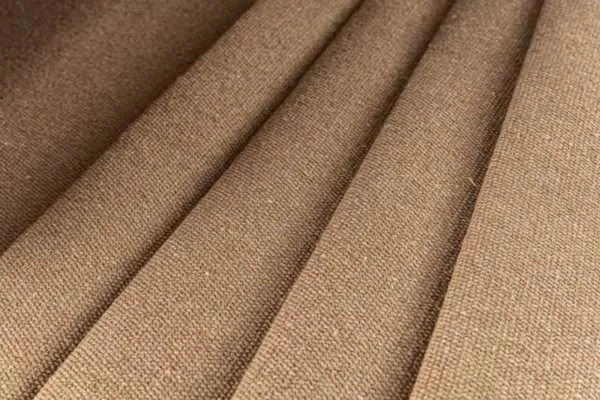
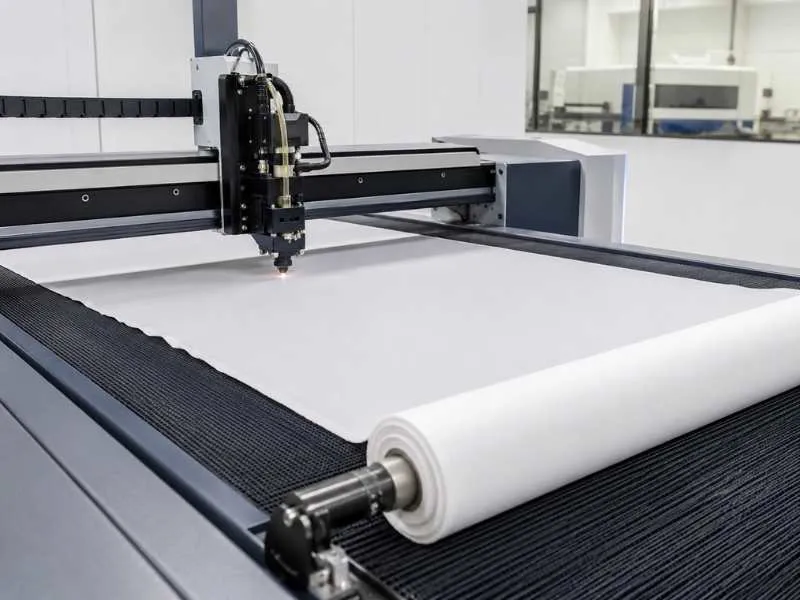
Wide dye-sublimated or other printed textile needs a camera view and feeding layout that can follow the artwork as the roll advances. Check the width, print distortion, fabric composition, and edge on a sample.

Embroidered Patches
Recognition must follow the stitched border of each patch, including variations between pieces. Send a representative sheet, patch size, spacing, backing details, and edge target.

Printed And Woven Labels
Small repeated motifs need reliable recognition and part pickup. Compare sheet layout, registration contrast, label composition, and cut-edge quality; use the dedicated label guide for print-and-cut workflows.

Printed Synthetic Leather
Camera alignment can follow graphics on flexible shoe or bag panels, but the complete coating and backing determine laser suitability. Confirm the composition first; do not laser cut PVC-containing stock.
Compare Two Published Vision Machine Layouts
Choose by printed feature, width, and feeding format. Model specifications describe the machine; sample testing determines the result on your material.
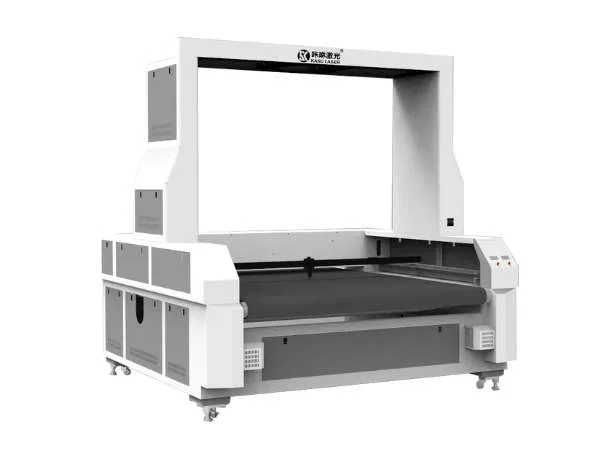
KD1814-S1 | Printed Fabric Rolls
- Layout: 1800 × 1400 mm, top camera, single CO₂ head and conveyor.
- Compare for: wide printed or embroidered flexible textile rolls.
- Confirm: print recognition, roll feeding, edge finish and output on your sample.

KX1810-F2 | Small Motifs On Flat Sheets
- Layout: 1800 × 1000 mm fixed table, side CCD camera and two CO₂ heads.
- Compare for: small printed or embroidered patches, labels and appliqués on sheets.
- Confirm: motif recognition, placement and cut edge on your sample.
Why Work With KASU On Vision Cutting?
Our team checks the actual job, then records what we can supply and support.

KASU Proves Recognition On Your Artwork
- We compare camera recognition, edge and part placement on your print, so the vision choice follows evidence from the real job. See KASU support.
- Our factory can confirm camera, table and feed configuration in writing for the approved material. See our manufacturing scope.
- Founded in 2009, KASU operates an 8,000+ sqm Suzhou factory with a published assembly and QC process. Inspect our factory.
Vision Laser Cutter Selection FAQ
When Is A Vision Laser Cutter Useful?
Use camera registration when the cut must follow a printed outline, registration feature, or embroidered border that can vary from the nominal design file. Test recognition on the actual artwork.
Which Machine Fits Printed Fabric Rolls?
KD1814-S1 is a published 1800 × 1400 mm, single-head top-camera conveyor model. Compare it for documented, laser-suitable flexible textile rolls; confirm print recognition, feeding and edge finish with a sample.
Which Machine Fits Small Labels Or Patches?
KX1810-F2 has a published 1800 × 1000 mm fixed table, side CCD camera and two CO₂ heads. Compare it for small printed or embroidered motifs laid out on sheets. Test the actual size and spacing.
Does A Second Laser Head Always Double Vision-cutting Output?
No. Output depends on recognition, nesting, cut path, handling and pickup. Compare cycle time on the real job rather than assuming a fixed gain from head count.
Can The Camera Make Any Material Safe For Laser Cutting?
No. Vision positioning only locates the cut. Confirm the complete fiber, coating, backing and adhesive first. Do not laser cut PVC-containing material.
What Affects The Price Of A Vision Laser Cutting Machine?
Working area, camera layout, number of heads, feeding equipment, extraction and the required production configuration affect a quote. Send the material and job details so KASU can recommend a suitable model before pricing.
What Should I Send For A Machine Recommendation?
Send material composition and coating details, a printed or stitched sample, part dimensions, roll width or sheet size, artwork or registration method, target output and destination. Include a sample when possible.
Explore The Specific Cutting Job
These pages cover specific materials and applications; this page compares the camera and machine layout.


Technical Support for Vision Laser Cutting Machine
Use these guides for camera recognition and textile edge questions; verify the exact job on a material sample.


Send Your Vision Cutting Job
Share material composition and coatings, a printed or stitched sample, part size, roll width or sheet size, registration method and target output. KASU can compare the published machine layouts and discuss a sample test and quote.
Address: No. 105, Nanzhangjing Road, Taicang, Suzhou, Jiangsu, China
Email: [email protected]
WhatsApp: +86-18601718317