
The wrong wood doesn’t just produce a bad cut. It torches your margins, triggers compliance violations, and poisons the relationship with the OEM client who trusted you to spec their substrate. I’ve watched a distributor lose a 500-unit repeat order because charred Baltic birch edges — preventable with a 15-minute material audit — failed the client’s incoming QC inspection. That’s not an aesthetic failure. That resets the client’s trust level to zero, and trust at that scale takes months to rebuild. I’ve watched OEM production lines grind to a halt because someone switched plywood suppliers mid-run without re-validating parameters. Choosing the right wood for laser cutting is not a cosmetic decision — it is an operational one.
This guide skips the hobbyist advice. If you’re a distributor building a material catalogue, an OEM manufacturer running CO2 lasers at duty cycles above 60%, or a system integrator advising industrial clients on substrate selection, this is written for you.
Can You Laser Cut Wood — and What Size Laser Do You Need?
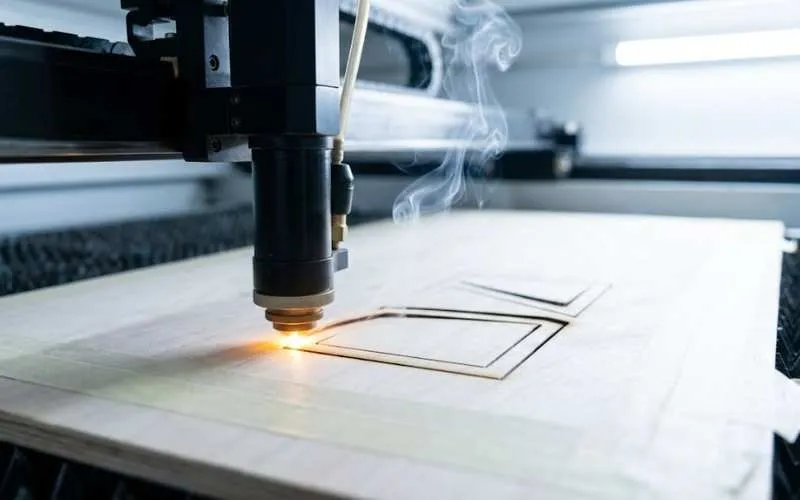
Yes. A CO2 laser cuts plywood, MDF, and most solid softwoods and hardwoods cleanly; for production work, plan on 60–100 W for 3–6 mm sheet and around 100 W with two or three passes for 12–18 mm Baltic birch. The 10.6 µm CO2 wavelength is absorbed well by wood, so the beam vaporizes the fibers and leaves a sealed, slightly darkened edge with no splintering.
What limits the cut is density and glue, not the word “wood.” Low-density basswood cuts fastest; dense hardwoods and MDF need more power per millimeter; plywood depends on its glue layers, and voids in cheap plywood cause missed cuts. Low-power diode lasers can cut thin veneer and 3 mm plywood slowly, but they are not practical for production thicknesses. The parameter matrix further down gives starting settings by wood type and thickness.
| Wood thickness | Typical CO2 power | Passes |
|---|---|---|
| Up to 3 mm (veneer, thin ply) | 40–60 W | 1 |
| 3–6 mm plywood / MDF | 60–100 W | 1 |
| 10–12 mm plywood | about 100 W | 1–2 |
| 18 mm Baltic birch | about 100 W | 3 |
Which Wood Is Best for Laser Cutting?
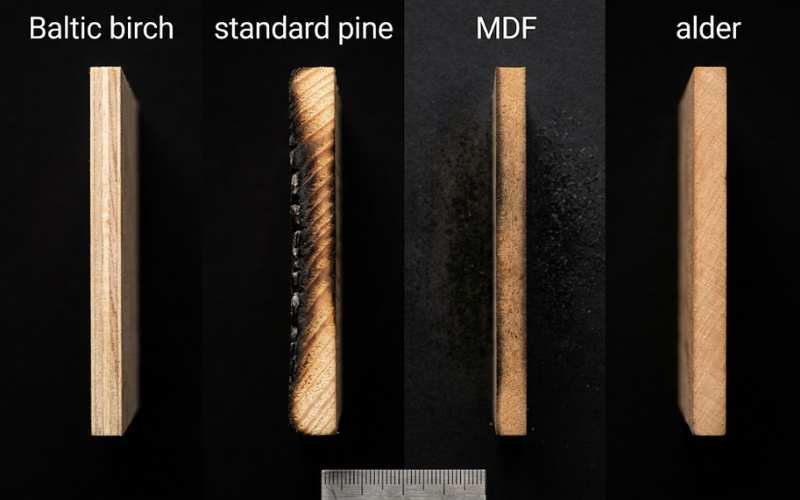
Baltic birch plywood is the most production-reliable wood for CO2 laser cutting. It combines consistent void-free core construction, predictable density, and a clean edge profile at thicknesses from 3 mm to 18 mm. For engraving-focused production, alder is the tightest alternative. For budget-sensitive OEM applications, laser-safe MDF works — but only with proper CARB Phase 2 compliance and extraction infrastructure in place.
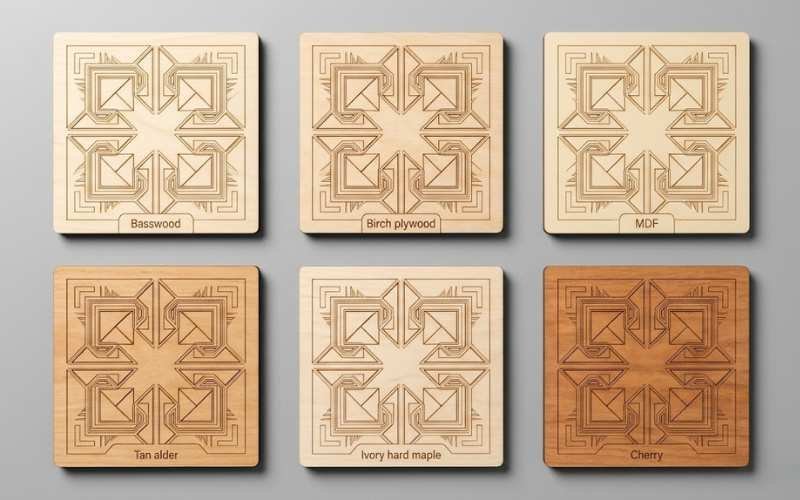
The table below ranks the six most viable wood types by production suitability:
| Wood Type | Density (kg/m³) | Max Cut Depth (100W CO2) | Edge Quality | Cost Index | Best B2B Application |
|---|---|---|---|---|---|
| Baltic Birch Plywood | 650–700 | 18 mm | ★★★★★ | $$ | Enclosures, signage, OEM components |
| Basswood | 320–450 | 15 mm | ★★★★★ | $ | Crafts, prototyping, gift product lines |
| MDF (CARB-compliant) | 700–800 | 12 mm | ★★★★☆ | $ | Flat-cut parts, display fixtures |
| Alder | 400–500 | 12 mm | ★★★★★ | $$ | Engraving, branded merch, plaques |
| Hard Maple | 700–820 | 10 mm | ★★★★☆ | $$$ | Awards, precision OEM parts, cutting boards |
| Cherry | 550–630 | 10 mm | ★★★★☆ | $$$ | Luxury décor, premium gift products |
Understanding What Makes Wood “Laser-Compatible”
Not all wood is created equal in front of a CO2 beam. Before I walk through specific species, you need to understand the four variables that actually determine whether a wood will perform consistently across a production run — not just on your test piece.
Density and Grain Uniformity
Uniform density is the single most important property for batch-consistent laser cutting. Woods with alternating hard and soft grain bands — Douglas fir, larch, cheap construction pine — force you into a losing trade-off: set power for the soft grain and you char the edges; set it for the hard grain and the soft sections blow out. At the production scale, this inconsistency translates directly into reject rates.
Hardwoods like maple and alder maintain tight, consistent grain throughout. Engineered woods like Baltic birch are manufactured for uniformity. These are the materials that let you lock a parameter set and run a full shift without babysitting the machine.
Resin Content — The Hidden Variable
Resin dictates how the wood vaporizes. High-resin species like pine produce darker, heavier char because the resin combusts rather than cleanly sublimating. This creates two problems: visual inconsistency across a batch, and accelerated contamination of your focusing lens and mirror set.
Running a 130W CO2 cutter through sustained pine sheets, lens cleaning intervals drop from every 8 hours to every 3 hours. That is downtime, consumable cost, and a maintenance variable your OEM clients did not budget for. I learned this on a 300-sheet pine run for a signage client. By sheet 180, beam quality had degraded enough to widen the kerf by 0.3 mm — enough to fail their dimensional tolerance spec. We re-ran 120 sheets. The client did not reorder.
Moisture Content — The Factor Most OEMs Ignore
Wood with moisture content above 12% does not cut cleanly. The beam loses energy to vaporizing water before it can cleanly ablate the cellulose. The result is a widened heat-affected zone (HAZ), inconsistent kerf width, and edge browning that no finishing operation can fully correct.
The production target is 6–8% moisture content (MC). Specify this explicitly when sourcing. Request moisture content certification from your supplier. If you’re storing sheet goods in an uncontrolled warehouse environment — even for two weeks — you can drift outside that window without knowing it.
Adhesive Chemistry in Engineered Wood
This is where compliance risk lives. Standard MDF uses urea-formaldehyde (UF) resin as its binder. When a CO2 laser vaporizes that binder, it releases formaldehyde gas — classified by IARC as a Group 1 human carcinogen. For distributors selling into markets with strict environmental health and safety requirements, this is not a background concern. It is a liability.
CARB Phase 2 and California Air Resources Board composite wood standards set formaldehyde emission limits that your MDF must meet before it enters a laser production environment. Specify CARB-compliant or E0/E1-rated MDF — and put that requirement in your supplier contract.
The 6 Best Woods for Laser Cutting (Ranked for B2B Production)
1. Baltic Birch Plywood — The Production Workhorse
Baltic birch is engineered plywood built from thin, uniform birch veneers with void-free cores and exterior-grade glue. That void-free construction is what separates it from standard hardware store plywood. Voids cause the beam to break through unexpectedly, creating blowouts, scorching the layer beneath, and making multi-pass settings unpredictable.
Why it dominates B2B production: Consistent batch behavior means one validated parameter set runs an entire pallet. The light, even surface engraves with high contrast. It ships flat and stays flat in humidity-controlled storage. It’s available globally in standardized sheet sizes, which simplifies MOQ planning considerably.
I’ve approved Baltic birch from three different supplier regions — Eastern Europe, China, and domestic North American mills. The Eastern European stock consistently shows the tightest veneer thickness tolerance, which translates to the most predictable multi-pass cutting behavior at 12 mm and above. That matters when you’re quoting a fixed-price OEM contract.
- CO2 parameters (100W): 6 mm — 85% power, 1,080 mm/min, 1 pass; 12 mm — 95% power, 600 mm/min, 2 passes
- Distributor note: Source from certified suppliers specifying E1 or better formaldehyde emission rating. CARB Phase 2 compliance is mandatory for US market clients.
2. Basswood — The Prototyping and Craft Standard
Basswood is the lowest-density commercial hardwood you’ll regularly encounter. Its fine, even grain requires minimal laser power and produces almost no char at correct settings. For distributors servicing craft product manufacturers, gift companies, or educational kit producers, basswood is the margin-friendly workhorse.
It is not suitable for structural OEM components. It dents, scratches, and lacks the surface hardness for products that will be handled repeatedly. But for engraved decorative items, model kits, and packaging inserts — it’s hard to beat the combination of low cost and clean output.
The first time I ran a grayscale photo engraving job on basswood versus birch side by side, the basswood result was noticeably sharper in the mid-tones. The uniform, low-resin grain gives the beam nowhere to scatter. For clients producing photo-engraved memorial or gifting products, that difference is visible to the end customer.
- CO2 parameters (60W): 6 mm — 70% power, 1,200 mm/min, 1 pass; 10 mm — 85% power, 720 mm/min, 2 passes
- Distributor note: Available in pre-dimensioned sheets, reducing material prep time. Margins are strong because per-sheet cost is low and finished product retail value is high.
3. MDF (CARB Phase 2 Compliant) — Cheapest Substrate, Highest Compliance Risk
MDF cuts cleanly. The uniform density — no grain, no knots, no voids — makes it ideal for flat-cut decorative panels, display components, and jig-making. At 60W, you can cut 6 mm MDF in a single pass at 1,500 mm/min with tight, clean edges. At 100W, you’re through 12 mm comfortably.
The problem is formaldehyde. OSHA sets the permissible exposure limit at 0.75 ppm TWA and 2 ppm STEL. Standard-grade MDF in a poorly ventilated shop will breach those limits during sustained cutting. For your clients operating in EU jurisdictions, EU Directive 2004/37/EC on carcinogens and mutagens applies. Ignorance of these standards doesn’t protect your client — or you, when they trace the liability back to your material recommendation.
I had a distributor client lose a procurement contract because their end customer’s EHS audit flagged inadequate fume extraction on the laser line. The MDF was cheap. The contract loss was not. Specify CARB Phase 2, E1-rated, or NAF (No Added Formaldehyde) MDF. Non-negotiable.
- CO2 parameters (80W): 6 mm — 80% power, 1,500 mm/min, 1 pass; 10 mm — 90% power, 900 mm/min, 1–2 passes
- Distributor note: Lowest material cost per square meter. Do not resell into production environments without confirming the buyer has adequate fume extraction infrastructure.
4. Alder — The Engraving Specialist
Alder is the quiet champion of wood laser engraving. Its low resin content, fine grain, and naturally light tan color produce deep, high-contrast burns at lower power than almost any other hardwood. The result is sharp, photographic-quality engraving with minimal post-processing.
The first time I ran Alder through a sustained 4-hour engraving job, the lens was cleaner at the end of the run than it had been after 90 minutes on basswood. That told me everything about Alder’s resin profile. For OEM clients running engraving at high duty cycles, that cleaner beam path translates directly to longer maintenance intervals and lower consumable spend.
One validated parameter set typically holds across a full pallet run, which is exactly what you need when billing by the hour on a production contract.
- CO2 parameters (80W): 6 mm — 65% power, 1,500 mm/min, 1 pass; 10 mm — 78% power, 840 mm/min, 2 passes
- Distributor note: Position alder as a premium engraving substrate. The clean output reduces finishing labor, which is the real cost argument for OEM buyers.
5. Hard Maple — Premium Output, Premium Price
Hard maple (Acer saccharum) is one of the densest commercial hardwoods at 700–820 kg/m³. Its fine, tight grain captures extraordinary detail in laser engraving — text at 6-point font size remains legible, and photographic grayscale engraving renders with exceptional tonal range. The ivory-cream surface provides natural contrast without staining.
The trade-off is machine demand. Dense wood at this hardness requires more power, slower feed rates, and better air assist to prevent scorching. At high duty cycles, you’ll see faster optic contamination compared to softer species — in our experience approximately 30% more frequent lens cleaning than alder at equivalent duty cycles. Budget for that in your production costing before quoting a fixed-rate contract.
- CO2 parameters (100W): 6 mm — 90% power, 840 mm/min, 1 pass; 10 mm — 95% power, 540 mm/min, 2 passes
- Distributor note: Best margin opportunity in the awards, plaques, and personalized corporate gift segment. Retail price on maple products runs 2–3× basswood with only a 40% higher material cost.
6. Cherry — For OEMs in Luxury and Gift Verticals
Cherry wood occupies a specific market position: premium aesthetics, medium laser demand, strong aging character. The reddish-brown surface develops a rich patina over months of light exposure — the engraved product actually improves in appearance over time. That aging quality is a genuine value proposition you can write directly into product descriptions for luxury gifting OEM clients.
Cherry cuts and engraves cleanly. Apply masking tape to the surface before loading to prevent smoke staining on unfinished areas. Peel after cutting. It adds 90 seconds to your setup and saves 10 minutes of surface cleaning per batch.
- CO2 parameters (80W): 6 mm — 75% power, 1,080 mm/min, 1 pass; 10 mm — 88% power, 660 mm/min, 2 passes
- Distributor note: Cherry commands premium retail pricing. Right material for OEM clients building wedding, anniversary, or executive gifting product lines.
CO2 Laser Parameter Matrix for Wood — Production Reference Data
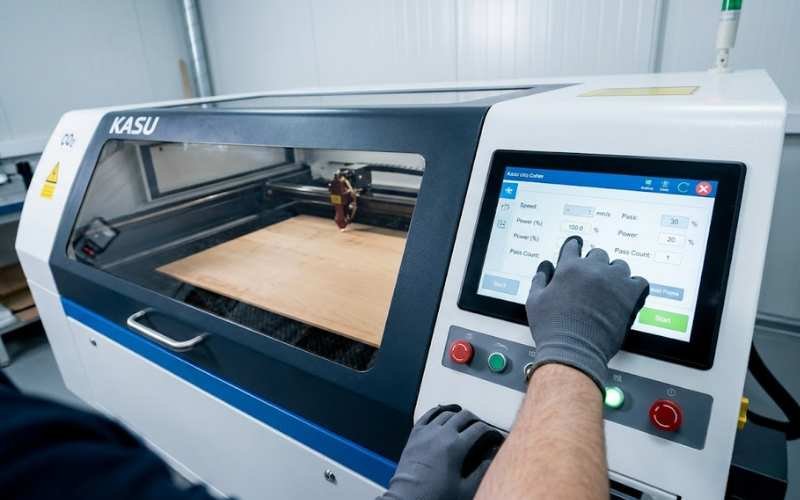
The following table consolidates validated parameters from KASU’s CO2 laser cutter production floor. These are starting points, not universal absolutes. Material batch variation, ambient humidity, lens focal length, and air assist pressure will all shift your optimal settings. Always run a 5-cut calibration sequence on a new material batch before committing to a full run.
A critical note on machine consistency: These parameters are reproducible because they were validated on a KASU CO2 platform maintaining power stability within ±3% across the full duty cycle. On platforms with ±10% or greater power variance — common in lower-cost machines — add a buffer pass to thick-material settings and widen your HAZ tolerance expectation accordingly. The substrate selection and the machine platform are not independent variables. For a broader reference on how power, speed, and focal point interact, this CO2 laser cutting parameters guide provides useful supplemental context.
| Wood Type | Thickness (mm) | Power (W) | Speed (mm/min) | Passes | Air Assist | HAZ Width | Notes |
|---|---|---|---|---|---|---|---|
| Baltic Birch Ply | 6 | 85 | 1,080 | 1 | High | 0.3–0.5 mm | Clean edge, minimal char |
| Baltic Birch Ply | 12 | 95 | 600 | 2 | High | 0.4–0.6 mm | Slight bottom-edge browning |
| Baltic Birch Ply | 18 | 100 | 420 | 3 | High | 0.6–0.9 mm | Multi-pass essential |
| Basswood | 6 | 70 | 1,200 | 1 | Medium | 0.2–0.4 mm | Risk of overburn; test first |
| Basswood | 10 | 82 | 720 | 1–2 | Medium | 0.3–0.5 mm | Reduce power if charring appears |
| MDF (CARB P2) | 6 | 80 | 1,500 | 1 | High | 0.3–0.4 mm | High fume output — extraction mandatory |
| MDF (CARB P2) | 10 | 90 | 900 | 1–2 | High | 0.4–0.6 mm | Dense smoke; monitor optics every 2 hrs |
| Alder | 6 | 65 | 1,500 | 1 | Medium | 0.2–0.3 mm | Best engraving consistency |
| Alder | 10 | 78 | 840 | 2 | Medium | 0.3–0.4 mm | Low resin — cleanest beam path |
| Hard Maple | 6 | 90 | 840 | 1 | High | 0.3–0.5 mm | Requires strong air assist |
| Hard Maple | 10 | 95 | 540 | 2 | High | 0.5–0.7 mm | 30% more frequent optic check vs. alder |
| Cherry | 6 | 75 | 1,080 | 1 | Medium | 0.3–0.4 mm | Mask surface before cutting |
| Cherry | 10 | 86 | 660 | 2 | Medium | 0.4–0.6 mm | Aging darkens contrast — improves over time |
All parameters tested on KASU CO2 laser platform, 10.6 µm wavelength, 2-inch focusing lens, air assist at 0.3–0.5 MPa. Laser cut tolerance for wood under controlled conditions: typically ±0.005 inches (0.127 mm). Per Xometry’s independent analysis, CO2 delivers better wood-cutting results than fiber laser for most non-metal wood substrates.
What Wood Should You Never Put in a CO2 Laser Cutter?
This section matters as much as the “best” list. A single batch of non-compliant material can contaminate optics, void a machine warranty, create a regulatory incident, or injure an operator.
| Material | Risk Level | Why It Fails |
|---|---|---|
| Pressure-treated lumber | ★★★★★ Critical | Contains chromated copper arsenate (CCA) — releases arsenic and chromium compounds when vaporized. Confirmed carcinogens. |
| Standard MDF (non-CARB) | ★★★★☆ High | Formaldehyde emissions exceed OSHA PEL in standard production without industrial extraction |
| Larch / Douglas Fir | ★★★★☆ High | Resin pockets cause unpredictable ignition; inconsistent grain produces erratic cut quality |
| OSB / Particle Board | ★★★★☆ High | Random adhesive distribution produces toxic off-gas; mechanical properties unpredictable |
| Plywood with marine glue | ★★★☆☆ Medium | Phenol-formaldehyde glue — lower risk than UF, but still requires verified extraction |
| Varnished or painted wood | ★★★★★ Critical | Coating chemistry unknown — chlorinated compounds possible, risk of HCl release |
| Tropical hardwoods (unlabeled) | ★★★☆☆ Medium | Unknown resin and preservative content; some species produce sensitizing dusts regulated by NIOSH |
The rule I apply with every new OEM client: if you cannot produce a material safety data sheet (SDS) and a formaldehyde emission certification, the sheet does not go into the machine. Full stop.
Fume Safety & Compliance — What B2B Operators Must Know
Let me be direct about something most material guides skip entirely: wood laser cutting produces regulated hazardous emissions, and your clients are legally accountable for managing them.
OSHA’s Formaldehyde Standard (29 CFR 1910.1048) sets hard limits: 0.75 ppm 8-hour TWA, 2 ppm STEL for 15-minute exposures. Cutting standard MDF without an industrial extraction system will breach those limits during sustained production runs. NIOSH occupational laser safety guidelines further require that employers conduct air monitoring when formaldehyde-releasing materials are processed.
For European market clients, EU Directive 2004/37/EC on carcinogenic and mutagenic agents sets legally binding occupational exposure limits that are in some cases stricter than OSHA’s. Formaldehyde — IARC’s Group 1 classified carcinogen — is explicitly covered under this directive.
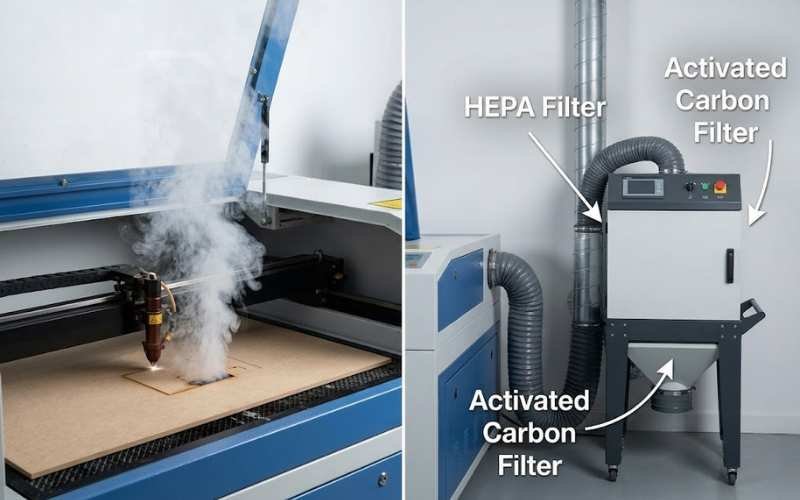
A compliant extraction setup requires:
- HEPA filtration to capture fine particulates down to 0.3 microns
- Activated carbon filter to adsorb formaldehyde and VOC gases — carbon filters saturate and must be replaced on a scheduled basis
- Extraction airflow rated for the machine footprint and material type — a blower fan pointed at a window is not a compliant extraction system under any jurisdiction
- Regular air quality monitoring when processing MDF, treated wood, or any adhesive-bound engineered wood at sustained duty cycles
The material recommendation and the safety infrastructure are inseparable. If you’re advising an OEM client on substrate selection, you are also advising them on their extraction requirements. Sell both together, or accept the liability of selling only half the picture.
Distributor & OEM Profitability Logic — Wood Selection by Margin, Not Just Cut Quality
The best wood for your business is the one that maximizes the value gap between raw sheet cost and finished product price, while keeping reject rate and machine operating cost at acceptable levels.
The following framework is based on US domestic retail sourcing averages, Q1 2025. Import pricing from verified Asian suppliers at MOQ above 50 sheets typically runs 20–35% lower on material cost, which shifts the margin calculation further in your favor at volume tiers.
| Wood Type | Sheet Cost (per m², US domestic) | Finished Product Example | Retail Value (per unit) | Reject Rate (trained operator) | Net Margin Direction |
|---|---|---|---|---|---|
| Basswood 6 mm | $8–$12 | Engraved ornament set | $25–$40 | <2% | ↑ High volume |
| Baltic Birch 12 mm | $18–$28 | Assembled wooden box | $45–$80 | <3% | ↑ High volume |
| Hard Maple 6 mm | $30–$50 | Corporate award plaque | $80–$150 | <4% | ↑↑ High unit margin |
| MDF CARB P2 6 mm | $5–$9 | Display fixture panel | $15–$30 | <2% | ↑ Cost-sensitive OEM |
| Cherry 6 mm | $35–$55 | Wedding keepsake box | $90–$160 | <5% | ↑↑ Premium vertical |
TCO scenario — commodity plywood vs. Baltic birch: Running 200 sheets of commodity construction plywood versus 200 sheets of CARB-certified Baltic birch through a 100W CO2 system over one month, the raw material cost difference is roughly $800–$1,200 in favor of the cheap plywood. Factor in a 12% reject rate on commodity stock versus 3% on birch, plus two additional lens cleaning cycles per week at 45 minutes each, and the net cost per 1,000 finished parts inverts. Baltic birch produces a lower effective cost-per-part by approximately $0.40–$0.80 per unit at volume. On a 10,000-unit OEM contract, that delta is not a rounding error — it is a margin.
On MOQ and lead time: Baltic birch from Eastern European or Chinese suppliers typically carries 2–4 week lead times for container volumes. Domestic sourcing shortens lead time to 3–7 days but adds 15–30% to per-sheet cost. Build that buffer into your delivery commitments — material delays on a laser line are a fast way to lose a client and a difficult problem to explain in a penalty clause conversation.
How to Test a New Wood Before Committing to Volume
Every new wood batch — even from a supplier you’ve used for two years — deserves a controlled qualification run. Batch-to-batch variation in adhesive chemistry, MC, and veneer thickness is real. It costs more in rejects than the 20 minutes of testing saves.
Here is the 5-step qualification protocol we use at KASU before approving any new wood substrate for client production:
Moisture check. Measure MC at five points across the sheet using a pin-type moisture meter. Reject any sheet above 10% MC. Flag any batch averaging above 8%.
Density spot-check. Weigh a known sample area (300 × 300 mm) and calculate density. Compare against supplier specification. Variation above 5% from spec warrants a full batch hold.
5-cut parameter sweep. Run 5 vector cuts at ±10% power and speed from your baseline settings. Inspect each: measure kerf width, HAZ width, and edge char depth with a loupe. Identify the setting that produces the narrowest HAZ with a complete, clean through-cut.
Smoke residue check. After the 5-cut sequence, inspect the focusing lens for contamination. Abnormal residue buildup in 5 test cuts indicates higher-than-expected resin or adhesive content in the batch. Investigate before committing to a production run.
Documentation. Log approved parameters, batch number, supplier certification, MC readings, and lens condition. This record protects you in any client dispute and builds a parameter library your operators can reference without re-testing on future batches from the same supplier.
The Real Cost of Getting Wood Selection Wrong
Here is what most material guides will not tell you: wood selection errors compound. A substandard substrate does not just produce one bad batch. It contaminates your optics, which degrades your cut quality on the next material. It inflates your reject rate, which your OEM client notices before you do. It exposes your operators to fumes that exceed regulatory limits, which creates a compliance record that follows your facility through audits.
The distributors and OEM manufacturers I’ve seen build durable laser cutting operations all share one practice: they over-invest in material qualification upfront and under-spend on rework downstream. That ratio is not a coincidence. The material decision made before the job starts determines 80% of the outcome after the job finishes.
Baltic birch for production volume. Alder for engraving quality. Maple and cherry for premium unit margin. MDF only under documented compliance conditions. Everything else stays out of the machine until you can prove it belongs there.
Ready to Validate Your Material and Machine Together?
The substrate parameters in this guide were developed on KASU CO2 laser hardware. If you’re evaluating whether your current machine platform can reproduce these results — or specifying equipment for a new wood-cutting production line — the material choice and the machine specification need to be validated together, not in isolation.
KASU works directly with distributors, OEM manufacturers, and system integrators to match machine specifications to real production requirements. We offer sample cut testing on your target materials before you commit to equipment. Contact the KASU technical team to request a technical consultation or arrange a production-scale cut test on your specific wood substrates.