
High-volume plastic fabrication often hits a wall when edge charring, toxic outgassing, and material wastage begin to erode your profit margins. For distributors and OEM manufacturers, these technical bottlenecks aren’t just operational nuisances; they are financial leaks that compromise your competitive standing in the global market. At KASU, we have spent years engineering laser systems that bridge the gap between high-speed throughput and surgical precision. This guide breaks down the essential physics of laser-plastic interaction and the economic logic that drives a successful distribution partnership.
What Plastic Materials Can You Cut with a Laser?
To achieve high-quality results, you must distinguish between thermoplastics, which melt and can be re-molded, and thermosets, which burn upon reheating. Most industrial laser cutting focuses on thermoplastics like Acrylic (PMMA), Polyoxymethylene (POM), and Polycarbonate (PC). According to ASTM D20 standards, the molecular structure of these polymers dictates their reaction to specific laser wavelengths.
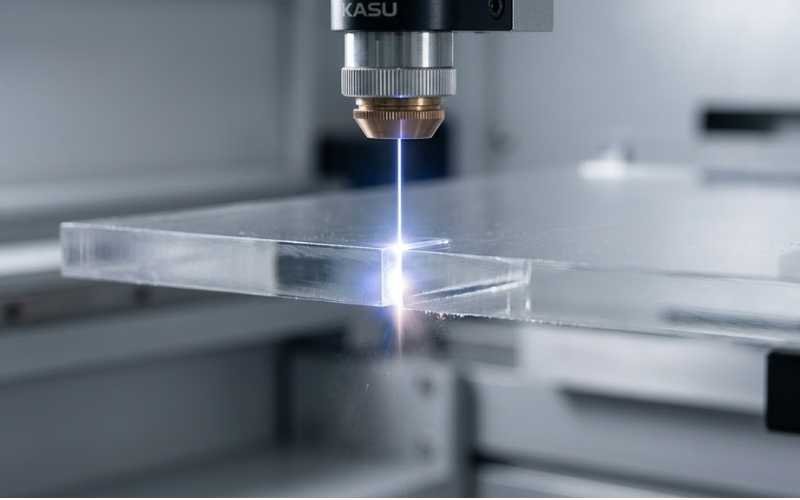
- Acrylic (PMMA): The “gold standard” for laser processing, yielding a flame-polished edge directly from the KASU CO2 Laser series.
- Polyoxymethylene (POM/Delrin): Excellent for mechanical gears; leaves a clean, burr-free finish.
- Polyester (PETG): Ideal for medical packaging and signage, though it requires precise pulse control to avoid yellowing.
- Warning (PVC & Teflon): Never process Polyvinyl Chloride or PTFE. These materials release chlorine gas and hydrogen cyanide, which are lethal to operators and corrosive to the laser’s motion system.
CO2 vs. Fiber Laser: The ,000 Decision for Distributors
Choosing the wrong laser source is a common mistake that many system integrators realize only after the first production run. For most plastic materials, the CO2 laser (10.6μm wavelength) remains the superior choice because polymers absorb this mid-infrared energy far more efficiently than the 1.06μm wavelength of a Fiber laser. In my experience at the KASU testing facility, using a Fiber laser on clear plastics often results in the beam passing straight through the material without cutting it.

Technology Performance Matrix
| Feature | CO2 Laser (10.6μm) | Fiber Laser (1.06μm) | Impact on ROI |
|---|---|---|---|
| Acrylic Cutting | Superior (Clear Edges) | Poor (Reflective/No Cut) | CO2 reduces secondary polishing costs. |
| Processing Speed | High for thick polymers | Low for non-metalized plastics | CO2 increases daily throughput. |
| Maintenance | Moderate (Gas/Mirrors) | Low (Solid State) | Fiber has lower OpEx but limited versatility. |
| Energy Efficiency | 10-15% Wall-plug | 30-35% Wall-plug | Fiber saves electricity but fails on physics. |
Master the Technical Parameters: KASU Lab Insights
In our lab, I’ve seen countless OEMs struggle with “beading”—those small melted spheres on the bottom of a cut. This usually happens because the operator focuses only on raw power rather than the Frequency (Hz) and Duty Cycle. To get a “glass-like” finish on 10mm Acrylic, you must balance the heat input so the material stays in a molten state just long enough to self-smooth, but not long enough to warp.
- Pulse Frequency: Lower frequencies (5,000 – 10,000 Hz) reduce the heat-affected zone (HAZ) in sensitive plastics such as polypropylene.
- Assist Gas Strategy: Use low-pressure Compressed Air for Acrylic to maintain the melt, but switch to High-Pressure Nitrogen (N2) for POM to prevent oxidation.
- Focus Position: For materials over 5mm, we set the focal point at 1/3 into the material thickness to ensure verticality of the cut edge.
KASU Internal Lab Test Data: Optimal Parameters
| Material Type | Thickness | Laser Power | Cutting Speed | Assist Gas |
|---|---|---|---|---|
| PMMA (Cast) | 5mm | 150W | 18 – 22 mm/s | Air (0.5 Bar) |
| POM (Delrin) | 3mm | 100W | 25 – 30 mm/s | N2 (2.0 Bar) |
| PC (Polycarbonate) | 2mm | 130W | 15 – 20 mm/s | N2 (4.0 Bar) |

Case Study: The 22% Margin Lift
Last year, a system integrator in Eastern Europe switched from a generic competitor to our KASU Vision Laser systems for their PETG production line. They were losing 15% of their material to thermal yellowing. By implementing our dynamic power adjustment software, they achieved a 99% yield rate. For a distributor, this translates to zero warranty claims and a reputation for “unbreakable” reliability.
The Hidden Economics: Total Cost of Ownership (TCO)
For a distributor, the sticker price of a machine is only 40% of the financial story. The real margin is found in the Total Cost of Ownership. When I consult with our global partners, I emphasize the “Consumable Chain.” This includes the lifespan of the laser tube, the cost of specialized filtration for VOCs (Volatile Organic Compounds), and the local availability of optics.
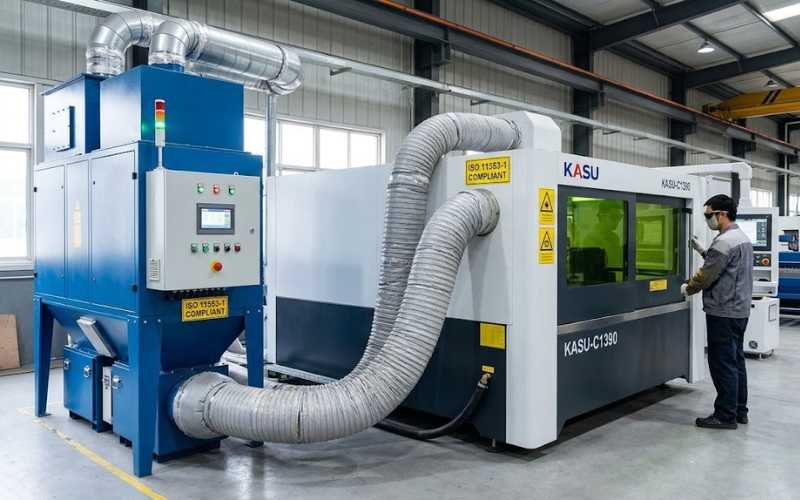
Effective exhaust systems are non-negotiable. Cutting 1,000 meters of PETG generates significant particulate matter. If your system isn’t compliant with ISO 11553-1 safety standards, you risk heavy fines and equipment degradation. KASU machines integrate multi-stage filtration to ensure your facility meets OSHA laser safety requirements without secondary overhead.
Why Systems Integrators Prefer KASU OEM Solutions
Smart factory integration requires more than just a “plug-and-play” USB port. Our systems provide a robust API for real-time monitoring of machine health and production metrics. We build our frames with high-tensile steel that undergoes stress-relief heat treatment. This prevents the microscopic gantry misalignments that cause “ghosting” in high-speed plastic engraving—a common failure in cheaper, lightweight alternatives.
We understand the pressures of international trade: lead time, shipping logistics, and customs documentation. KASU provides comprehensive technical dossiers for every machine, ensuring that when our units arrive at your warehouse, they pass local inspections immediately. Our modular design means that if a component fails, your customer isn’t down for weeks waiting for a proprietary part; we use globally standardized electronics where it matters most.

Strategic Advantage for Your Portfolio
Success in the plastic fabrication market isn’t about having the highest wattage; it’s about the precision of energy delivery and the reliability of the motion system. By selecting a machine that respects the chemical properties of polymers, you transform a simple tool into a high-margin production asset. Distributors who prioritize these technical nuances find themselves with fewer support tickets and higher customer retention rates.
Scalable Growth with KASU
Ready to upgrade your distribution portfolio or integrate precision laser modules into your OEM line? We provide the technical backbone and engineering support to help you dominate the local market. Contact our engineering team today for a custom TCO analysis and a detailed breakdown of our current shipping schedules for international partners.