
Laser cut wood covers laser cutting and laser engraving for wood sheets and panels.
Many buyers struggle with dark burn edges, smoke stains, and slow cutting speeds when working with wood. These problems often come from using the wrong wood type, incorrect power and speed settings, or a laser machine that is not matched to material thickness. Over time, this leads to higher scrap rates, rework, missed delivery dates, and higher unit costs for export orders.
This guide gives you clear, production-focused guidance. You will learn how laser cutting and laser engraving on wood differ, how a laser wood cutter interacts with real wood materials, and how to choose equipment and settings that improve edge quality, reduce waste, and keep your lead times under control.
Laser Cut Wood and Wood Laser Engraving
Laser cut wood refers to using a focused laser beam to cut, mark, or engrave wood materials. The laser removes material by heat, following a digital design file. This process creates detailed shapes and fine surface marks without physical contact.
For B2B buyers, laser cut wood supports fast design changes and short production cycles. It is widely used in signage, displays, packaging, and light industrial parts. Compared with saws or CNC routing, laser cutting reduces setup time and eliminates tool wear.
Wood laser engraving is often used for logos, text, and surface patterns. Laser cutting goes through the full thickness to separate parts. Knowing which process you need helps you set correct quality, speed, and pricing expectations.
What Is Laser Cutting and Laser Engraving on Wood
Laser cutting on wood uses a high-energy beam to cut through the material along a programmed path. The beam replaces blades and router bits, producing narrow kerfs and tight tolerances.
Laser engraving on wood uses lower power or higher speed. It removes only a surface layer to create contrast. Both processes usually run on the same machine, with different settings.
From a production view, this means one laser wood cutter can handle marking and cutting in one setup. This reduces handling time and alignment errors in batch production.
Common uses include:
- Signs and branding panels
- Custom packaging inserts
- Wooden tags and labels
- Architectural and interior panels
Laser Cutting vs Wood Laser Engraving
Laser cutting separates parts. Wood laser engraving adds information or decoration to the surface. The difference is depth, speed, and purpose.
Cutting goes through the full thickness and runs at higher power. Engraving removes a thin layer and runs faster. Buyers should specify clearly whether a job includes cutting, engraving, or both.
| Feature | Laser Cutting on Wood | Wood Laser Engraving |
|---|---|---|
| Depth | Full thickness | Surface layer |
| Power | Higher | Lower |
| Speed | Slower | Faster |
| Purpose | Separate parts | Add markings |
| Result | Cut edges | Engraved contrast |
Planning artwork correctly reduces cycle time and controls unit cost.

How a Laser Wood Cutter Works on Wood Materials
A laser wood cutter uses a CO₂ laser source in most wood applications. The beam travels through mirrors and a focusing lens to the wood surface.
The beam heats the wood until it burns or vaporizes. Air assist removes smoke and debris from the cut zone. Motion systems move the laser head or table based on the design file.
Wood type, resin content, glue layers, and moisture level affect cut quality. Softwoods burn faster. Hardwoods cut slower but engrave with stronger contrast. Engineered panels add glue lines that change edge color.
Key system components:
- CO₂ laser tube
- Mirrors and focusing lens
- X/Y motion system
- Air assist nozzle
- Exhaust and fume extraction
- Control software
General laser cutting principles are described by Wikipedia and show how material absorption and heat behavior affect results, especially for organic materials like wood. External reference: https://en.wikipedia.org/wiki/Laser_cutting
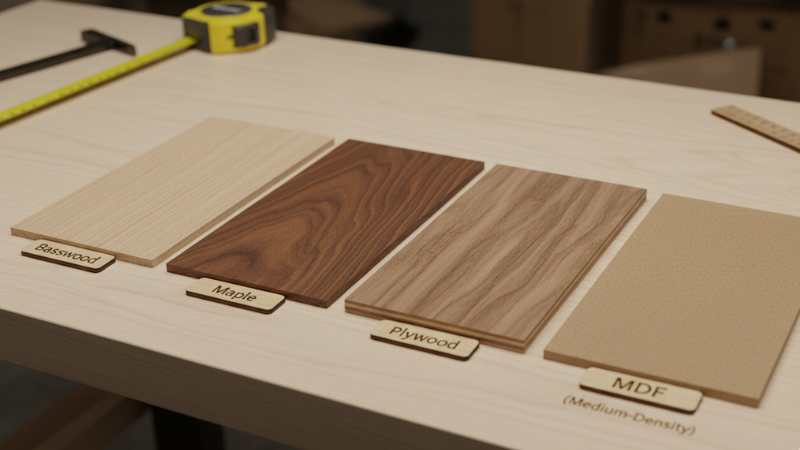
Best Types of Wood for Laser Cutting and Engraving
Stable grain, low resin, and consistent density give the most reliable laser results. Moisture content and glue type also affect edge color and engraving quality.
Different woods behave very differently under a laser. Softwoods cut fast but burn unevenly. Hardwoods engrave with better contrast but cut slower. Engineered panels offer size consistency but introduce glue layers.
Choosing the right wood early reduces scrap, shortens setup time, and helps you hit delivery schedules.
Softwoods for Laser Cut Wood
Softwoods cut quickly and cost less, but resin and grain variation often cause dark edges. They work best for prototypes, rustic designs, and low-cost parts.
Balsa Wood
Cuts very fast at low power. Best for models and lightweight parts. Low strength and fragile edges limit use in production parts.
Basswood
Fine, even grain with low resin. Delivers clean cuts and smooth engraving. A common choice for signage, branded items, and detailed work.
Pine
Low cost and easy to source. Resin and knot areas cause uneven burns. Better for structural or rustic parts than for fine engraving.
Hardwoods for Laser Cut Wood
Hardwoods engrave with stronger contrast and look more premium. Higher density means slower cutting and higher power needs.
Maple
Light color and tight grain. Produces clean engraving and good detail. Common for plaques, signs, and precision branding.
Walnut
Dark base color with deep engraved look. Used for premium decorative parts. Slower cutting speeds required.
Oak
Open grain causes uneven engraving. Better for large graphics than small text. Strong grain pattern affects fine detail.
Cherry
Smooth grain and rich contrast. Popular for awards and high-end branded parts. Predictable engraving behavior.

Engineered Wood for Laser Cut Wood
Engineered panels offer flatness and size consistency for production, but glue layers affect edge color and smoke.
Plywood for Laser Cutting
Glue layers burn darker than wood fiber. Results vary by supplier. Laser-grade plywood reduces edge char.
MDF for Laser Engraving
Very even density for engraving. Heavy smoke and dark edges when cutting. Best for painted or coated parts.
Veneered Wood Panels
Hardwood look with engineered core. Shallow engraving only to avoid cutting through veneer. Good balance of cost and appearance.
Production tip: Always laser-test each wood batch before bulk orders.
Laser Cut Wood Projects and Applications
Laser cut wood supports decorative, functional, and commercial products. Design changes require no tooling, which shortens lead time and lowers setup cost.
Thin sheets and good nesting improve throughput. Thicker parts slow cutting and affect unit cost.
Decorative Laser Cut Wood Projects
Focus on appearance and fine detail.
Common uses:
- Wall art and decorative panels
- Personalized signs
- Ornaments and gifts
- Interior accents
Functional Laser Cut Woodworking
Focus on fit and repeatability.
Typical uses:
- Flat-pack furniture parts
- Jigs and fixtures
- Drawer inserts
- Packaging trays
Commercial Laser Cut Wood Products
Focus on volume, cost, and delivery.
Common products:
- Point-of-sale displays
- Retail signage
- Educational kits
- Promotional packaging parts
Balsa Wood Stand Laser Cut Template Applications
Balsa stands cut fast and suit lightweight displays.
Typical uses:
- Product mock-up stands
- Model bases
- Lightweight holders
- Education project supports
Laser Cut Wood Settings and Process Optimization
Correct power, speed, and focus settings directly control edge quality and scrap rate. Small changes can shift results from clean edges to heavy charring.
Power, Speed, and Focus for Wood Laser Engraving
General rules:
- Higher speed for light marking
- Lower speed for deeper contrast
- Surface focus for sharp detail
- Slight defocus for wider fills
Always test before production.
Cutting Thickness Limits for Laser Cut Wood
Typical single-pass ranges for CO₂ lasers:
- 40–60 W: up to 3–4 mm
- 80–100 W: up to 6–10 mm
- 130–150 W: up to 12–15 mm
Wood density and glue layers reduce effective limits.
How to Reduce Burn Marks and Charring
Practical steps:
- Increase cutting speed
- Use strong air assist
- Apply masking tape
- Choose low-resin wood
- Keep optics clean
Air Assist and Masking for Wood Laser Cutting
Air assist clears smoke and reduces flare-ups. Masking tape protects light surfaces and veneer panels from stains.

Choosing the Best Laser Cutter for Wood
The best laser cutter for wood matches your thickness, sheet size, and volume. Overbuying increases cost. Underbuying limits capacity.
CO₂ Laser vs Diode Laser for Wood Cutting
CO₂ lasers cut thicker wood and work faster. Diode lasers suit thin materials and light engraving.
For most commercial wood applications, CO₂ lasers are the practical choice.
Key Specifications of a Wood Laser Cutter
Laser Power Requirements
Power controls speed and max thickness. Higher wattage improves throughput.
Working Area and Bed Size
Larger beds support full sheets and better nesting.
Cooling and Exhaust Systems
Stable cooling protects the laser tube. Strong exhaust protects surfaces and optics.
Wood Engraving Equipment for Hobby, Workshop, and Business Use
- Hobby: small diode or low-power CO₂
- Workshop: mid-power CO₂
- Business: higher-power CO₂ for batch production
What Makes the Best Laser Cutter for Wood
Look for:
- Stable power output
- Accurate motion system
- Strong exhaust and air assist
- Local service and spare parts

Common Problems in Laser Cut Wood and How to Solve Them
Most issues come from material choice, setup, or maintenance.
Incomplete Cuts and Inconsistent Depth
Causes include low power, dirty optics, or uneven thickness. Clean optics and slow speed before raising power.
Excessive Smoke Stains on Wood
Weak exhaust, low air assist, or resin-heavy wood increase staining. Improve airflow and use masking.
Warping, Cracking, and Edge Deformation
Wet wood and high heat cause warping. Use dry material and increase speed.
Adhesive Layer Issues in Plywood
Glue layers burn darker and block penetration. Use laser-grade plywood and test each batch.
Laser Cut Wood vs Traditional Wood Cutting Methods
Laser cutting changes setup, design freedom, and batch economics.
Precision and Design Freedom
Lasers handle tight curves, fine text, and internal features without tool changes.
Production Efficiency and Repeatability
For short to medium runs, lasers reduce setup time and improve consistency.
Cost Comparison for Wood Cutting Machines
Lasers reduce tooling cost but require higher machine investment. CNC routing may suit thick parts but needs tools and setup.
Safety Considerations for Laser Cutting and Engraving Wood
Wood cutting creates smoke and fire risk. Proper systems and monitoring are required.
Fumes, Smoke, and Ventilation
Strong exhaust protects operators and optics. Poor ventilation causes residue and health risks.
Fire Risk and Material Monitoring
Wood is flammable. Never leave machines unattended. Clean debris trays and watch for flare-ups.
Safe Wood Types for Laser Cutting
Only cut clean, untreated wood and laser-safe panels. Avoid chemically treated or unknown materials.
FAQs About Laser Cut Wood and Wood Laser Engraving
What is the best wood for clean engraving?
Basswood, cherry, and maple deliver consistent contrast.
Can you laser cut thick hardwood
Yes, within power limits. Multiple passes may be needed.
Does plywood always cut poorly
No. Laser-grade plywood cuts more evenly.
Is MDF safe to laser cut?
It can be cut, but it produces heavy smoke and needs strong exhaust.
Final Thoughts on Laser Cut Wood and Wood Laser Cutter Selection
Laser cut wood gives speed, flexibility, and design freedom that traditional methods cannot match. The right wood choice, correct settings, and properly sized equipment directly affect quality, scrap rate, and delivery performance.
For B2B production, focus on repeatability, material consistency, and support infrastructure. These factors protect margins and help you meet customer expectations.
Talk to a Wood Laser Cutting Specialist
If you are sourcing or upgrading wood laser cutting equipment, choose systems matched to your material thickness, sheet size, and production volume.
Contact our export team to discuss your wood applications, request technical guidance, or get machine specifications for your production needs.
Wikipedia – Laser Cutting:U.S. OSHA
– Wood Dust and Safety: CDC/NIOSH