
Is Your Fabric Choice Burning Your Profit Margins?
In high-volume OEM production, “guessing” if a fabric is laser-safe is a fast track to voiding your warranty and endangering your floor staff. I’ve seen factory managers ruin $5,000 optics in a single shift because they processed “synthetic leather” that turned out to be PVC-based. It’s not just about the cut quality; it’s about the chemical byproduct hitting your lenses and your lungs.
If you are a distributor or a system integrator, your priority is yield and uptime. You need materials that don’t just “cut” but “perform” under 16-hour duty cycles. Choosing the wrong substrate doesn’t just result in a charred edge—it results in a corrosive micro-environment that eats your linear guides for breakfast.
Which Fabrics Are Guaranteed Safe for Industrial CO2 Lasers?
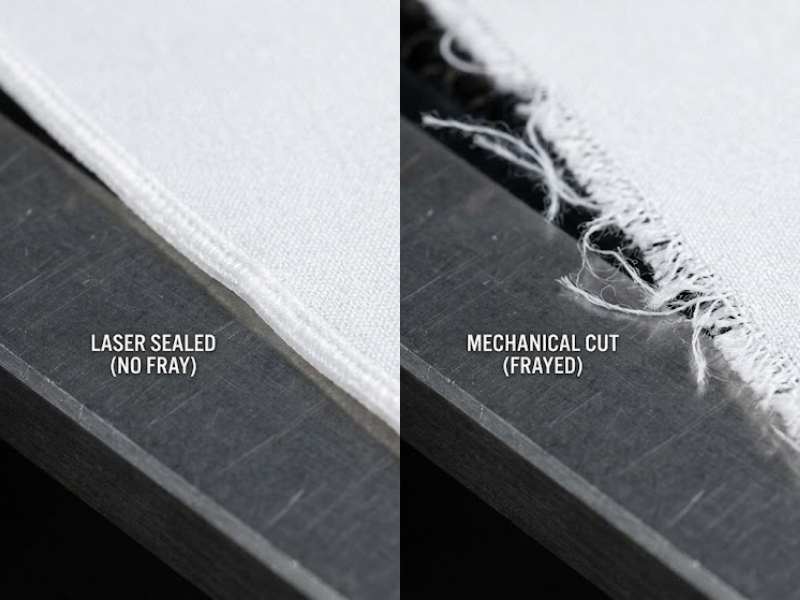
The short answer for high-speed production: Polyester, Nylon, Cotton, Linen, and Silk are your safest bets. These materials interact predictably with the 10.6μm wavelength of a CO2 laser. Synthetics like Polyester (PET) are the industry favorite because they melt and self-seal, while natural fibers like Cotton vaporize into a clean, albeit slightly darkened, edge.
The “Safety” of a fabric is determined by its molecular bond. If it contains Chlorine (like PVC), it’s a “Machine Killer.” If it’s a pure polymer or a natural cellulose fiber, it’s a “Production Winner.”
The “Safe-to-Scale” Material Matrix
| Material Category | Technical Response | B2B Advantage | Risk Factor |
|---|---|---|---|
| Polyester (PET) | Thermoplastic Melting | 100% Sealed Edges; No Fraying | Low (Melting residue) |
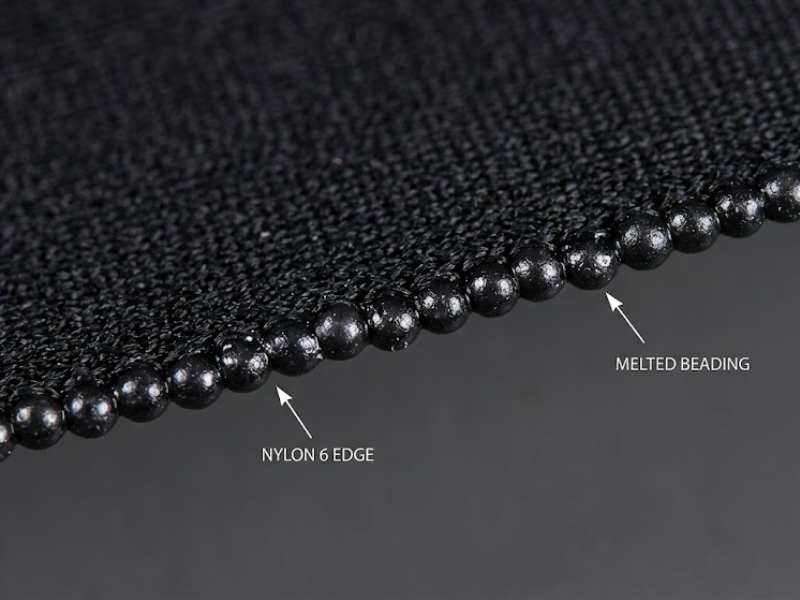
| Nylon 6 / 66 | Rapid Liquefaction | High-strength for Airbags/Chutes | Moderate (Yellowing) |
| Natural Cotton | Sublimation (Burning) | Breathable; No toxic off-gas | High (Fire risk) |
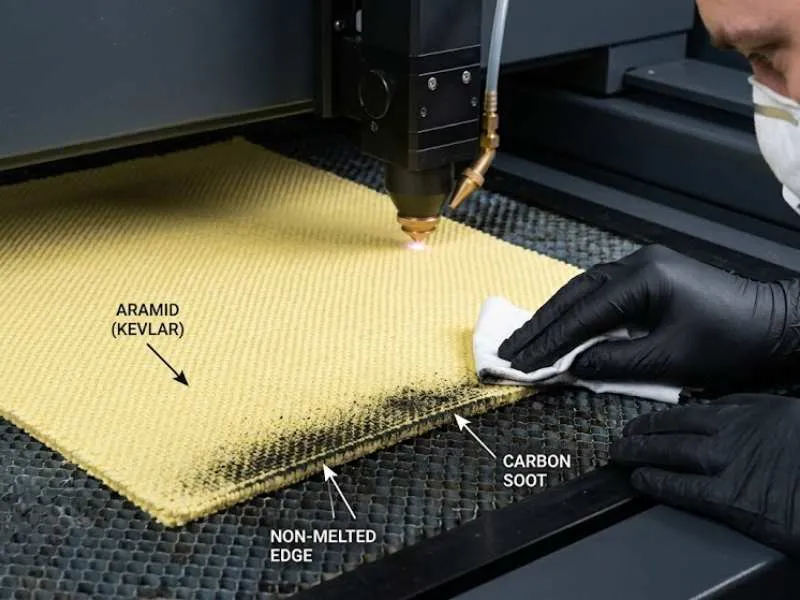
| Aramid (Kevlar) | Carbonization | Non-melting; High heat resistance | Low (Edge soot) |
| PU Leather | Vaporization | High-end look without PVC toxins | Low (Smell) |
Why Does My “Safe” Synthetic Still Yellow at the Edges?
Even with “safe” fabrics like Nylon or certain white Polyesters, you’ll often see a yellowish tint on the cut line. This isn’t a “bad” fabric; it’s a gas management failure. When the laser melts the plastic, the vaporized resin stays in contact with the material for too long.
- The Solution: You need a down-draft vacuum table. At KASU, we don’t just blow air at the nozzle; we suck the fumes through the fabric.
- The Insight: If you’re an OEM cutting white sportswear, high-pressure nitrogen assist can replace compressed air to prevent oxidation (the yellowing). It costs more per hour but saves thousands in rejected QC batches.
The “Never-Process” List: Machine Killers and Toxic Risks
If a supplier offers you a “cheap” vinyl or a mystery “flame-retardant” textile, walk away unless you have an MSDS (Material Safety Data Sheet.
1. PVC (The Silent Corroder)
Polyvinyl Chloride is the enemy of the CNC world. Heating it releases Hydrogen Chloride gas, which combines with humidity to form Hydrochloric Acid. This acid will pit your chrome-plated rails and cloud your ZnSe lenses in less than 8 hours of run time. If it smells like a swimming pool, stop the machine immediately.
2. PTFE (Teflon) / Halogenated Coatings
Found in high-end technical “stay-clean” fabrics. These release fluorinated gases. Unless you have a scrubbed, industrial-grade filtration system that costs as much as the laser itself, do not touch these.
3. “Bonded” Leathers
Many distributors get burned here. Genuine leather is fine. But “bonded” leather uses chemical adhesives to hold scraps together. Those adhesives are often unknown polymers that can flare up or release cyanide-based fumes.
How Do I Maximize ROI on Natural Fibers?
Cotton, Linen, and Denim are “safe,” but they are fire hazards. Unlike synthetics that melt, natural fibers provide fuel. To run these at 400mm/s without starting a fire, your Air Assist must be set to at least 0.2 MPa.
- Distributor Tip: If you are selling laser systems to garment manufacturers, emphasize Nesting Software. Since natural fibers don’t “self-seal,” the precision of the cut allows for tighter nesting (0.5mm gaps), which can improve material yield by 15% compared to manual die-cutting.
- Technical Reality: Wool is safe but smells like a biological hazard during the cut. Ensure your external exhaust fan is rated for at least 2000 m³/h for every 1.5m of bed width.
The Bottom Line for Your Floor Manager
“Safe” is a relative term in a factory. A fabric is only as safe as the extraction system supporting it. If you want to move from 100 units a day to 1,000, you stop worrying about the “cut” and start worrying about the cycle time.
- Polyester is your profit leader—sealed edges mean zero post-processing.
- PVC is your liability—it will kill your machine’s resale value and your staff’s health.
- PU (Polyurethane) is the only “pleather” you should ever put on a KASU conveyor.
Partner with a Technical Authority
Don’t let a sales rep tell you “everything is fine.” We provide material testing reports for your specific substrates before you sign a PO. We verify the edge melt, the fume toxicity, and the maximum effective cutting speed on our Gantry and Galvo systems.
[Request a Material Compatibility Test from KASU Engineers]