

What A Medical Textile Cutting Machine Must Get Right
Quick answer: A medical textile cutting machine cuts nonwoven and hygiene web materials to a digital outline without a die. In this sector the cutting step is judged on edge integrity and particle generation as much as on dimensional accuracy.
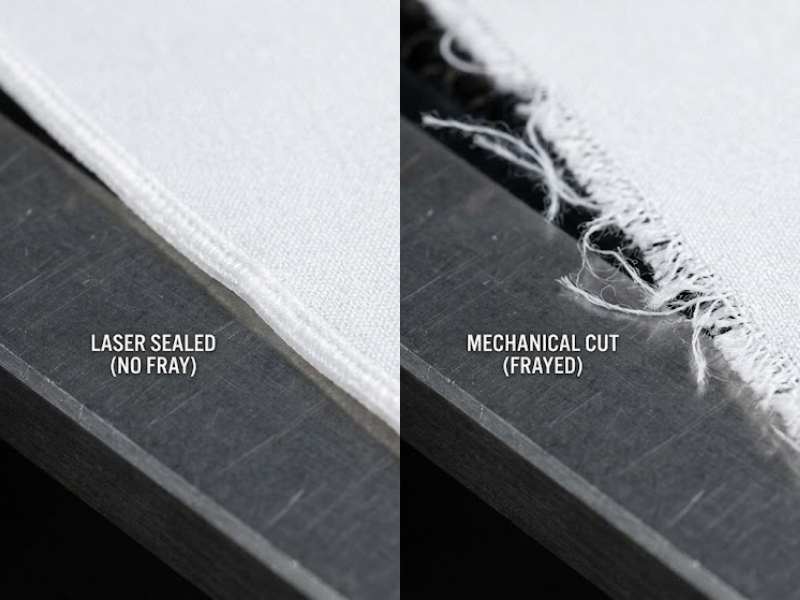
Medical textiles fail differently from apparel fabric. A gown panel that is 1 mm out of tolerance is usually still usable; a gown panel that sheds fibre into a sterile field is a rejected lot. That is why the material class moved toward non-contact cutting: a laser has no blade to shed particles and no mechanical pressure to distort a 15 gsm spunbond web. It also fuses polypropylene and polyester filament ends locally at the cut, which reduces the loose-fibre count along the edge compared with rotary shear. What it will not do is cut PVC-based tubing stock or heavily chlorinated barrier films — those release chlorine compounds under the beam and belong on a knife. Nor does a cutting machine by itself confer any regulatory status: validation, cleanroom class and lot traceability remain the converter’s system. We supply the machine, the parameter record and the sample evidence that feeds into it. Material background for this class is maintained by INDA, the association of the nonwoven fabrics industry.
Medical Textile Materials And How The Beam Handles Each
Four web families cover most medical and hygiene enquiries. The middle bullet is where converters usually get surprised.

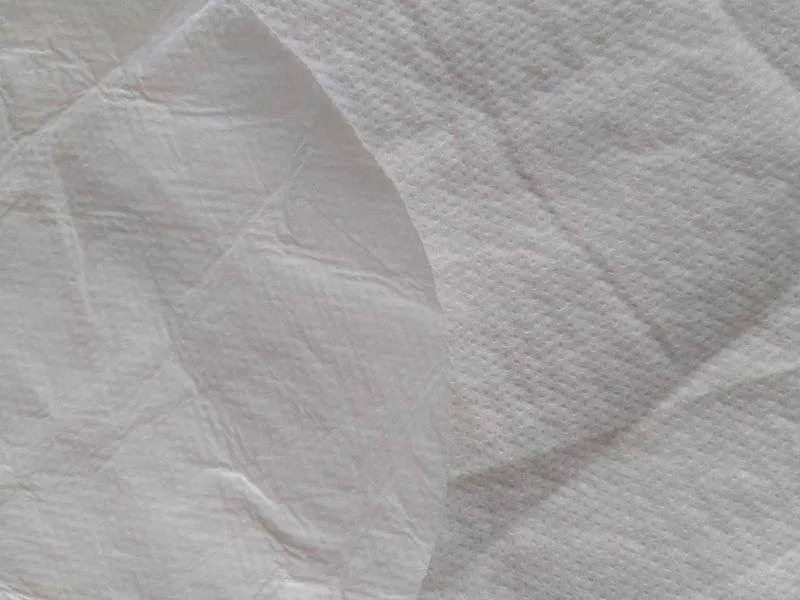
SMS And Spunbond Nonwoven
- Formats: polypropylene spunbond and SMS, 10–60 gsm, roll widths to 2.4 m, used for gowns, drapes and caps.
- Watch out: at 15 gsm the web has almost no stiffness. Any mechanical blade drags it, and the part comes off dimensionally correct in the file but stretched in reality.
- How we cut it: vacuum hold-down plus non-contact cutting — nothing pushes the web sideways. Polypropylene filament ends fuse locally, reducing loose fibre at the edge.
Breathable Film Laminate
- Formats: microporous PE film laminated to spunbond, 30–90 gsm, used for surgical gowns and protective coveralls with AAMI barrier ratings.
- Watch out: the barrier lives in the film layer. Excess heat at the cut can locally close or distort the micropores, and a barrier claim is exactly the thing an auditor will test.
- How we cut it: lowest workable power with high feed rate, then we return cut samples so your lab can run the barrier test before you commit to the machine.

Gauze And Cotton Web
- Formats: woven and needled cotton gauze, absorbent pads, 20–200 gsm, for dressings and swabs.
- Watch out: cotton is cellulose — it has no melt phase, so the beam chars rather than seals. On white dressing stock the resulting brown edge line is a cosmetic reject.
- How we cut it: we run your actual gauze first and photograph the edge. If the char is unacceptable for your product we will say so and point you to a blade system instead.

Filter And Barrier Media For Masks
- Formats: meltblown polypropylene filter layers, nose-wire carrier strip, ear-loop web.
- Watch out: meltblown is charge-carrying — the filtration efficiency comes from an electrostatic charge that heat and handling can degrade.
- How we cut it: minimal dwell time at the cut line and no contact pressure across the face of the media; efficiency retention is verified on your sample, not assumed.
Medical Textile Products Cut Without A Die
Die-less cutting matters most where a product family carries many sizes, or where a specification changes and the tooling would have to be rebuilt.

Surgical Gowns And Coveralls
- Parts: body panels, sleeves, cuffs and tie strips in SMS and film laminate, across four to six sizes.
- The hard part: a barrier-rated gown is a certified product. Once the pattern is validated, a die change means re-validating — so most converters freeze the design and lose the ability to respond to customers.
- What you get: the pattern lives in a file. A size or seam-allowance change is a nesting job, and the parameter record travels with it for your validation file.

Drapes And Sterile Barrier Sets
- Parts: fenestrated drapes, table covers, instrument wraps, procedure-pack components.
- The hard part: a drape set is many different shapes in one kit, in low volume per shape — the worst possible case for steel-rule tooling economics.
- What you get: every shape in the kit is cut from the same nested layout on the same roll, so kit variety costs nesting time rather than tooling.

Face Masks And Respirator Blanks
- Parts: pleated mask blanks, cup-shaped respirator layers, meltblown inserts, ear-loop and nose-strip components.
- The hard part: masks are multi-layer and the layers behave differently — a parameter that suits the outer spunbond can degrade the meltblown charge underneath.
- What you get: layers cut separately at their own parameters rather than as a compromise stack, with the settings recorded per layer.

Wound Dressings And Absorbent Pads
- Parts: pad blanks, adhesive-border shapes, island dressings, hydrocolloid outlines.
- The hard part: adhesive-backed stock gums up blades quickly, and residue transfer between parts is a contamination question in this sector rather than a nuisance.
- What you get: nothing physically contacts the adhesive face, so there is no blade to load up and no transfer path between parts.
Recommended KASU Machines For Hygiene And Nonwoven Rolls
Choose by roll width and by whether the job is continuous roll production or short kit runs. All three share the same control software. The full range is on the KASU machine category page.

K1814-S2 Double Head Auto Feeding Laser Cutting Machine
- Cuts: SMS and spunbond rolls, film laminate, mask layers, dressing blanks.
- Specs: 1800×1400 mm cutting zone, automatic feeding, two heads on one bed.
- Best for: continuous roll production where the same part repeats all shift.

K1814-SY Roll-to-Roll Double Head Laser Cutting Machine
- Cuts: lightweight nonwoven web, breathable laminate, meltblown media.
- Specs: 1800×1400 mm zone, roll-to-roll transport, double head.
- Best for: material that must stay on the roll from unwind to rewind rather than be handled as sheets.

KD2016-AF Large Flatbed Top Vision Laser Cutting Machine
- Cuts: wide drape stock, printed or marked barrier material, large gown panels.
- Specs: 2000×1600 mm bed, top camera registration, automatic feeding.
- Best for: wide rolls and kit work where many different shapes come off one layout.
Non-Contact Cutting Is A Hygiene Argument Before It Is A Quality One
Blades touch the product, need cleaning, and wear. A beam touches nothing and has no edge to dull. On medical textiles that is the first argument, not the last — and it is also why the conversation moves quickly to which materials should not be on a laser at all.
Distributors and OEM partners: KASU offers free OEM/ODM — custom models, your brand colours and logo, multilingual labelling, with no extra service charge. Details on About KASU.

Send Your Own Nonwoven Or Laminate For A Free Sample Cut
- Send your SMS, breathable laminate, gauze or filter media. Basis weight and layer build set the window, not the product name.
- We cut your blanks and return them, so barrier and filtration testing runs on real parts rather than on our description of them.
- Parameters recorded per material and shipped with the machine.
- For distributors: medical converters validate once and then reorder for years. The validation is slow and the relationship that survives it is durable — which makes the sample cut the most valuable thing you can offer early.

Meltblown Is The One To Check First
- Meltblown filter media is heat-sensitive by definition — the electrostatic charge that gives it efficiency is exactly what excess heat removes. Efficiency has to be tested after cutting, on your own media, by you.
- Multi-layer cutting is possible on some builds and a bad idea on others; layer bonding at the kerf is what decides it, and it is checked on a sample.
- What we will not claim: cutting equipment carries no medical device approval and does not confer one. Your validation remains yours.
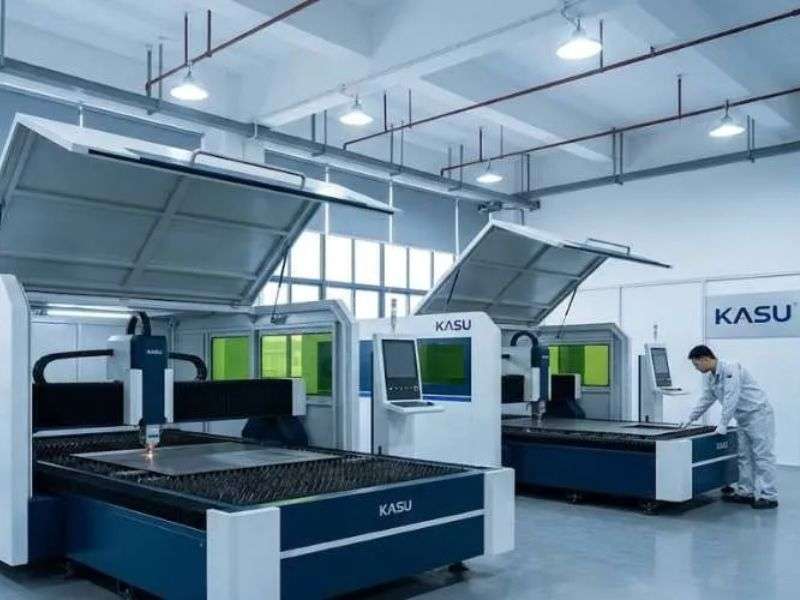
The Factory That Builds Your Medical Textile Cutter
- Founded 2009 · Shanghai R&D · 8,000+ m² Suzhou plant, 15 minutes from the R&D centre.
- 100+ models across 9 series, 70+ owned patents and software copyrights, China High-Tech Enterprise.
- Machines are built in-house rather than traded, so a parameter question reaches the people who built the motion system and specified the extraction.
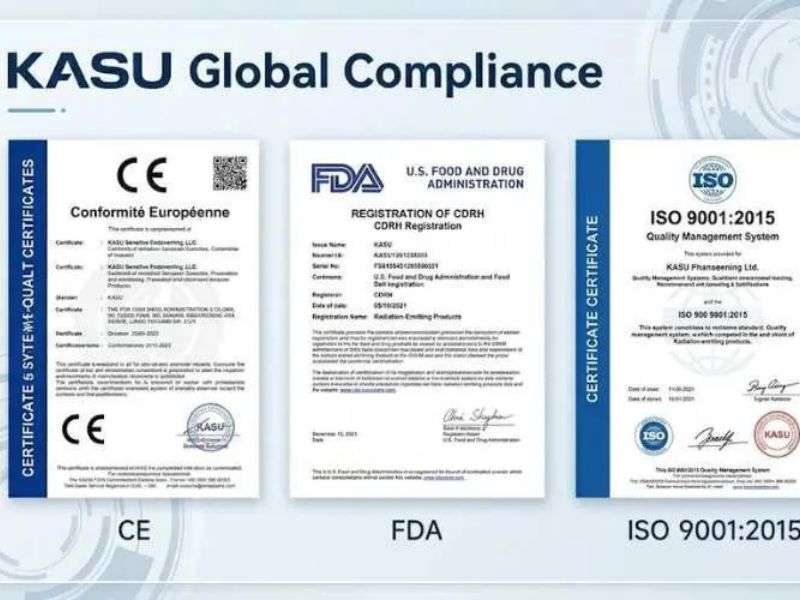
CE And FDA Certified — Validation Samples Cut On Your Own Media
- CE and FDA certified; 5,000+ customers across 80+ countries.
- Installation guidance, operator training and spare parts supplied from the factory that built the machine.
- Class-1 enclosed configurations available where the destination market requires them.
Buyer Questions On Nonwoven And Hygiene Web Cutting
Does Laser Cutting Contaminate Medical Textiles?
Laser cutting is non-contact, so no blade material transfers into the web and no mechanical pressure is applied. There is localised heating at the cut line and fume extraction is required. Whether the process meets your cleanroom and validation requirements is determined by your own qualification testing — we supply cut samples and the parameter record to feed into it.
Can The Machine Cut Meltblown Filter Media Without Losing Efficiency?
In most cases yes, because dwell time at the cut is short and nothing presses on the media face. Electrostatic charge retention still varies by media supplier and basis weight, so we ask for your actual meltblown and return samples for your own efficiency testing before quotation.
What Does A Medical Textile Cutting Machine Cost?
Cost is driven by working area, head count, feeding system and camera type rather than a list price, so we quote against a specification. Send roll width, gsm, material type and target daily output and we return a configuration with pricing. Sample cutting is free.
Which Medical Materials Should Not Go On A Laser?
Anything PVC-based or heavily chlorinated releases chlorine compounds under a CO2 beam — that is a plant-safety issue, not a quality one, and we will tell you to use a knife system instead. Cotton gauze cuts but chars at the edge, which is often a cosmetic reject on white dressing stock.
Can We Cut Several Layers At Once?
Multi-layer stacking is possible on some nonwovens but it is usually the wrong choice here, because layers in a medical laminate need different parameters and a stack forces a compromise. We normally recommend single-ply cutting with a double-head machine for throughput instead.
Do You Supply OEM Or ODM Machines For Our Brand?
Yes. KASU Laser provides free OEM and ODM service including custom configuration, brand colour and logo, and multi-language labelling and manuals, with no extra service charge.
Related KASU Cutting Solutions
Three neighbouring pages covering the specific web materials most often quoted alongside medical and hygiene textiles.


Technical Support for Medical Textile Cutting
Background reading on material screening, cut-quality comparison and machine selection, aimed at converters specifying a first non-contact cutting system.


Get A Medical Textile Cutting Machine Quotation
Send your material type, gsm, roll width, part mix and daily output target. We confirm laser suitability, run a free sample cut and return the parameter record alongside the machine configuration.
Address: No. 105, Nanzhangjing Road, Taicang, Suzhou, Jiangsu, China
Email: [email protected]
WhatsApp: +86-18601718317