
You can laser engrave fabric without cutting through it, but the result must be tested on the actual textile. A visible mark is not enough: the cloth must remain suitable for its intended use. Check for holes, brittle fibers, melted areas and damage on the reverse side before approving a job.
Fiber, dye, weave and finish all change how fabric reacts to a CO₂ laser. This guide explains how to screen a material, run a small engraving test and decide whether the result is ready for production.
What does laser engraving do to fabric?
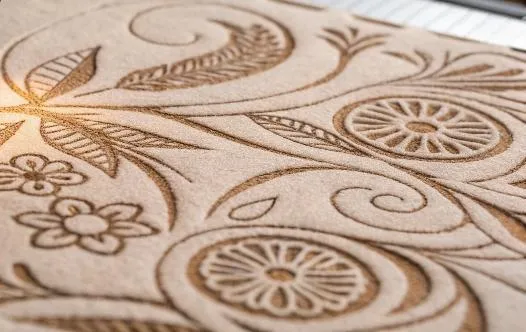
Engraving changes the surface; cutting passes through the cloth. Dark cotton or denim may develop a lighter mark as the laser changes its dye. Canvas may darken. Synthetics can melt or turn glossy. The appearance depends on the exact fabric and finish, so a setting from another roll is only a starting reference.
Even without a visible hole, too much energy can weaken the marked area. Compare both faces of the sample with untreated cloth. If the finished product will be washed, wash a marked sample before approving the process.

For indigo denim, see how to get a clear laser mark while checking fabric strength.
Which fabrics can you try?
Start with a known, uncoated fabric and a swatch from the production lot. Dark, tightly woven cotton, denim, canvas and some felts can give readable marks. Thin, stretchy, raised-pile or synthetic fabrics need particular care because they may scorch, flatten or melt before the design has enough contrast.
| Fabric | Inspect for |
|---|---|
| Cotton or denim | Even contrast and no brittle yarns after washing |
| Canvas or felt | A readable design without heavy residue or flattened pile |
| Polyester or blends | No glossy melt, curling or stiff patch |
Confirm the fiber, coating and adhesive from the supplier’s documentation. Do not engrave an unknown material. Keep PVC-coated fabric out of the laser: MIT’s laser cutter safety guidance identifies hazardous hydrogen chloride from PVC processing. For through-cutting rather than marking, see KASU’s fabric cutting guide.
How do you find a setting without burning through?
Use an approved starting profile, then make a small test grid on the exact fabric, color and finish you will run. Do not copy a power percentage from another machine. Record your laser, lens, focus, speed, power, resolution, airflow and number of passes.
- Lay the swatch flat. Hold it in place without covering the test area. Use the machine’s normal extraction and operating procedure.
- Begin with a light mark. Test a line and a small filled patch. Change one variable at a time; higher speed and lower power are often a useful starting direction.
- Inspect both sides. Choose the lightest setting that gives the required contrast. Reject holes, reverse-side scorching, melted film or a stiff surface.
- Test finished use. For washable goods, wash a sample under its intended care conditions and compare it with an untreated control.
If the machine cannot produce a consistent light mark, or the fabric weakens before the design becomes readable, stop and review the material or process. More power is not a cure for poor contrast.
How do you make the result repeatable?
Keep the fabric flat, the focus consistent and the artwork simple enough for the weave. A fold can make one area darker; loose cloth may move during the job. Fine photographic detail can disappear in coarse or raised fabric. Separate engraving paths from any cutting paths in the file.
Approve a physical swatch under the lighting in which the product will be judged. Record its material lot, artwork revision, machine profile and inspection result. Re-test when the supplier changes the dye or finish. If a customer requires formal laundering evidence, agree on a method such as AATCC TM61 before claiming wash durability.
If the job also needs cut parts, qualify that as a separate operation. KASU’s fabric laser cutting systems page covers material handling for cutting jobs.
Frequently asked questions
Can a CO₂ laser mark fabric without cutting it?
Yes, on some verified fabrics. Approve the mark only after checking both faces and the cloth’s usable condition.
What power should I use?
There is no universal percentage. Start with the machine maker’s permitted profile and test the actual fabric for the lightest acceptable mark.
Will the engraving survive washing?
It depends on the fiber, dye and finish. Wash a marked sample under the product’s intended care conditions before making that claim.
Can polyester be engraved?
Some polyester fabrics can be marked, but heat may cause gloss, melting or stiffness. Check the exact blend and finish first.
Can I engrave coated fabric?
Only after confirming the coating and adhesive composition. Do not laser-process unknown or PVC-coated textiles.
For a production trial, send the fabric specification, a swatch, the artwork and the required appearance after use or washing. KASU can review whether a CO₂ laser test is suitable and provide a sample for approval.