

What Laser Die Cutting Replaces, And What It Does Not
Quick answer: Laser die cutting produces the same shapes a steel-rule or rotary die produces — outlines, kiss-cuts, perforations and crease lines — using a focused beam instead of a physical tool, which removes tooling cost and lead time from short and variable runs.
The honest way to describe this category is as a trade-off rather than an upgrade. A rotary die on a long, stable, single-shape job will out-run a laser and cost less per thousand; nothing changes that. What a die cannot do is exist the same afternoon the artwork does, change when the customer revises the shape, or handle a job of two hundred pieces without the tooling swallowing the margin. That is the whole case, and it is a strong one because most converting work has been drifting toward shorter runs and more versions for two decades. The technical limits should be stated too. Anything PVC-based is excluded — the beam releases chlorine compounds that attack extraction ducting and raise a plant-safety question. Thick board above roughly 3 mm cuts but shows a darkened edge that is unacceptable on premium packaging. And a laser crease is a scored line, not the folded, compressed crease a matrix produces, so folding carton work usually still wants a creasing tool. Converting and carton industry standards are published through FEFCO.
Materials Suited To Die Cutting Without A Die
Four stock families cover most enquiries. The middle bullet is where the trade-off actually bites.

Self-Adhesive Label Stock
- Formats: paper and PP facestock on glassine or PET liner, 60–200 µm facestock, in sheets and rolls.
- Watch out: kiss-cutting means stopping in the adhesive without marking the liner. The window between too shallow and cut-through is narrow and it moves with liner type — and a scored liner breaks on the rewind, not on the machine.
- How we cut it: power and speed set against your actual liner, verified by peeling a test sheet rather than by inspecting the top surface.

Plastic Film And Sheet
- Formats: PET, PP, PC and acrylic film and thin sheet, 50 µm to 3 mm, for overlays, membrane panels and insulators.
- Watch out: PVC and PVC-blended film is excluded outright — chlorine release is an equipment-corrosion and plant-safety issue, not a quality one. Film is often unlabelled, which is how it gets loaded by mistake.
- How we cut it: we require the material specification before running. PET and PP cut with a locally fused edge that resists tearing better than a die-cut edge.

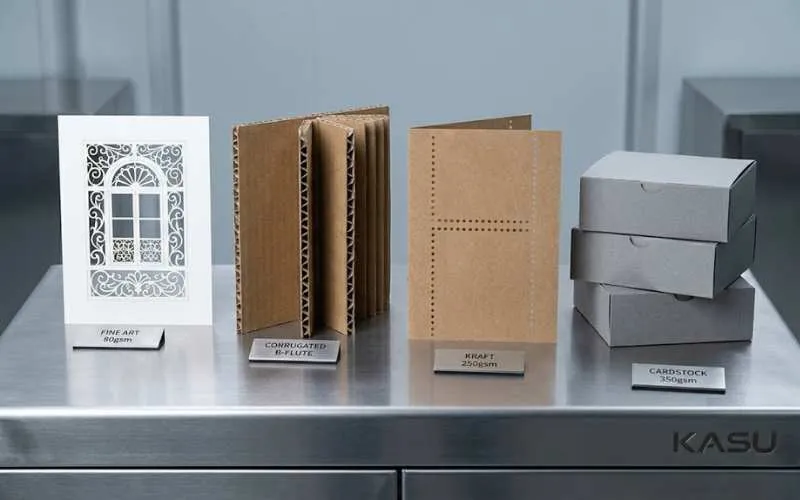
Paper, Card And Thin Board
- Formats: 80–600 gsm paper and card, greyboard and chipboard to about 3 mm, for packaging, inserts and display work.
- Watch out: above roughly 3 mm the cut edge darkens visibly. On a hidden insert nobody cares; on a premium carton it is a reject, and that judgement is yours rather than ours.
- How we cut it: we cut your actual board and photograph the edge at your thickness so the call is made on evidence. See our cardboard page for board-specific work.

Thin Gasket And Insulation Sheet
- Formats: non-asbestos sheet, EVA and PE foam, felt and fibre sheet to about 5 mm for flat seals and insulators.
- Watch out: gasket orders are small and frequent, which is why die cost per part so often exceeds part value — but rubber-loaded grades produce fume loads that need real extraction.
- How we cut it: same-day sample rings from a drawing, with extraction specified for the binder content you actually use. See our gasket page.
Die Cutting Jobs That Are Better Without Tooling
Every case below has the same shape: many versions, short runs, or a deadline shorter than tool making.
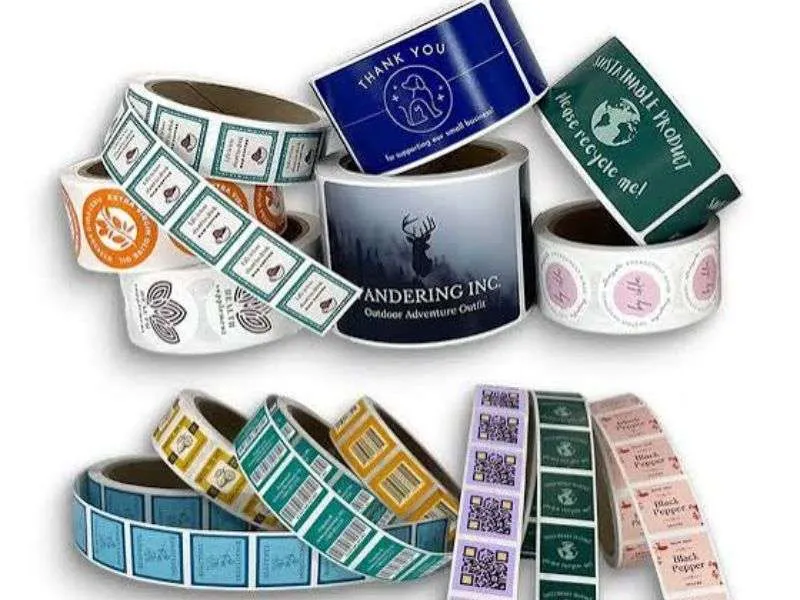
Short-Run And Versioned Labels
- Parts: shaped labels, decals, kiss-cut sheets, promotional and seasonal versions.
- The hard part: a shaped label die costs the same whether the run is five hundred or five hundred thousand, so short versioned work is where converters lose money quietly.
- What you get: the shape is artwork. Version count stops being a tooling decision, and a same-day reprint stops being an exception. See our label cutting page.

Membrane Panels And Graphic Overlays
- Parts: printed polyester and polycarbonate overlays, windows, button apertures, adhesive spacer layers.
- The hard part: overlays are precise, printed, and revised whenever the product’s firmware or labelling changes — a die per revision is unworkable.
- What you get: apertures cut in register with the print, and a revision costs a file update rather than a tool.

Packaging Prototypes And Structural Samples
- Parts: carton and insert samples, display mock-ups, structural iterations before tooling is committed.
- The hard part: a structure that goes to tooling untested is expensive to be wrong about, but sampling by hand is slow and inaccurate.
- What you get: a physical sample the same day the structural file exists, cut and creased to the real dimensions.

Flat Gaskets, Shims And Insulators
- Parts: flat seals, washers, spacer shims, electrical insulator shapes in thin sheet.
- The hard part: these orders are small, frequent and geometry-specific — the textbook case where die cost per part exceeds the value of the part.
- What you get: parts cut from a drawing with no minimum order dictated by tooling economics.
Recommended KASU Machines For Tool-Free Converting
Choose galvo-gantry for small repeating shapes at speed, flatbed for large single blanks. All run the same control software. The full range is on the KASU machine category page.

KC-1280 CO2 Galvo Gantry Integrated Laser Cutting Machine
- Cuts: small repeating shapes — labels, gaskets, insulator blanks, perforation fields.
- Specs: galvo scanning head on a gantry, 1200×800 mm class working area, CO2 source.
- Best for: high shape-repetition work where galvo speed beats gantry-only motion.

KDC-1614S CO2 Galvo Gantry Integrated Laser Cutting Machine With Top Camera
- Cuts: printed label stock, graphic overlays, registered kiss-cut work.
- Specs: 1600×1400 mm class area, galvo-gantry head plus top camera registration.
- Best for: printed work where the cut has to follow artwork rather than a nominal position.

KX1390-F1 CCD Laser Cutter With Blade Knife Table
- Cuts: board, card, thin sheet and packaging blanks needing a rigid support surface.
- Specs: 1300×900 mm blade knife table, CCD camera registration.
- Best for: board and sheet work where a knife table gives a cleaner underside than honeycomb.
Against A Rotary Die At Volume, You Should Buy The Rotary Die
Laser die cutting is not faster than a rotary die on a long run of one label. It is faster than making the die. Everything that follows is about which of those two facts describes your work.
Distributors and OEM partners: KASU offers free OEM/ODM — custom models, your brand colours and logo, multilingual labelling, with no extra service charge. Details on About KASU.

Send Your Own Stock For A Free Sample Cut
- Send your self-adhesive stock, film, board or gasket sheet with the liner you actually use.
- Kiss-cut depth is the thing to test — face severed, liner intact — and the window depends on your liner caliper, not on ours.
- Parameters recorded per stock and shipped with the machine.
- For distributors: the buyer here is usually already outsourcing die-cut work and paying a tooling charge per version. Versioned and short-run labels are the wedge; they are the jobs the trade shop quotes badly.

Creasing And Exclusions — The Two Honest Limits
- A beam does not crease. It can perforate a fold line, which is not the same thing and does not behave the same on a folding carton. If a proper crease is required, a creasing tool is required.
- PVC and PVC-based stock are excluded — see PVC Cutting Systems.
- Where laser wins outright: versioned short runs, structural samples, and any shape that would otherwise need a new die.
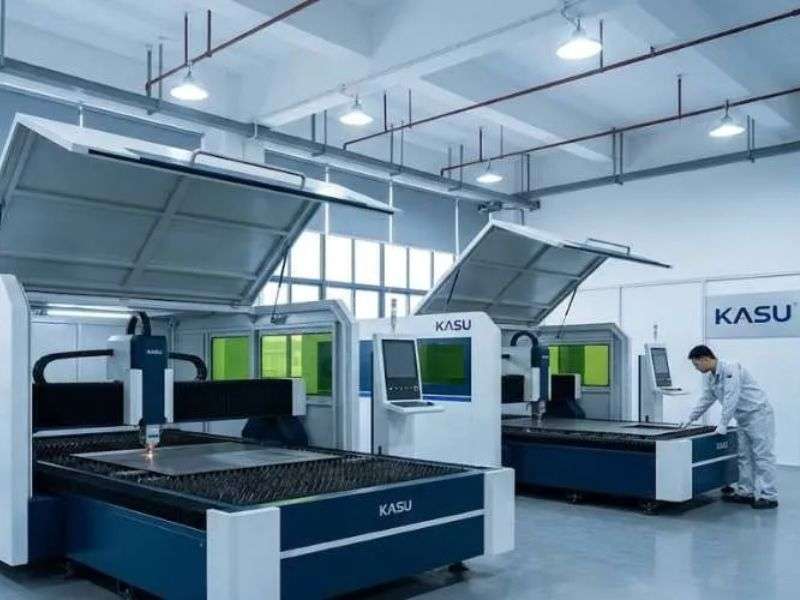
The Factory That Builds Your Laser Die Cutter
- Founded 2009 · Shanghai R&D · 8,000+ m² Suzhou plant, 15 minutes from the R&D centre.
- 100+ models across 9 series, 70+ owned patents and software copyrights, China High-Tech Enterprise.
- Machines are built in-house rather than traded, so a parameter question reaches the people who built the motion system and specified the extraction.
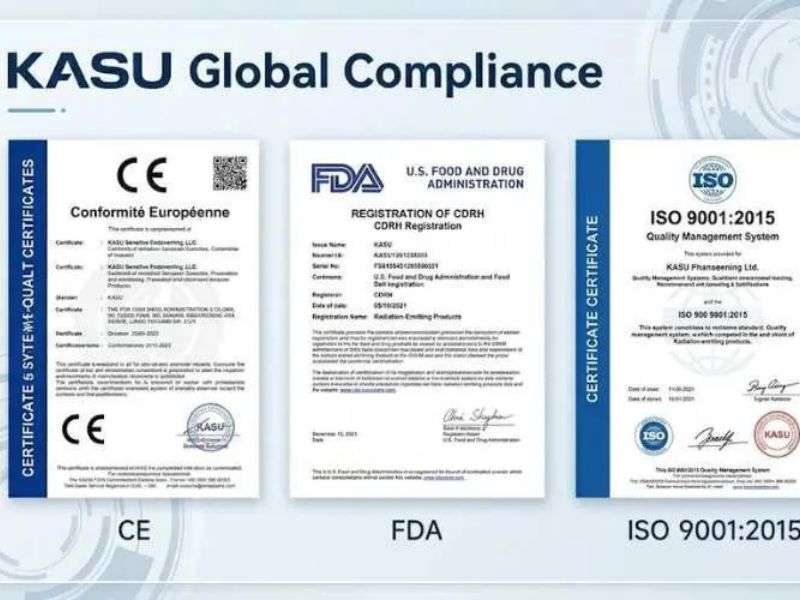
CE And FDA Certified — Send Your Stock For A Free Sample Cut
- CE and FDA certified; 5,000+ customers across 80+ countries.
- Installation guidance, operator training and spare parts supplied from the factory that built the machine.
- Class-1 enclosed configurations available where the destination market requires them.
Buyer Questions On Cutting Without Tooling
Is Laser Die Cutting Faster Than A Rotary Die?
Not on long single-shape runs — a rotary die will out-run it and cost less per thousand. Laser wins where tooling cost and lead time dominate: short runs, many versions, prototypes and jobs where the shape changes. Most converters end up running both and routing work by run length.
Can It Kiss-cut Self-adhesive Label Stock?
Yes. The beam is set to sever the facestock and adhesive while leaving the liner intact. The window between too shallow and cut-through is narrow and moves with liner type, so we set the parameter on your actual stock and verify it by peeling a test sheet rather than by inspecting the top surface.
Can It Crease Folding Carton?
It can score a fold line, but a laser score is not the folded, compressed crease a creasing matrix produces. For production folding carton, creasing usually stays a tooling operation. For structural samples and prototypes a laser score is normally sufficient, which is the main packaging use of this machine.
Which Materials Are Excluded?
Anything PVC-based or PVC-blended. The beam releases chlorine compounds that corrode extraction ducting and raise a plant-safety issue rather than a quality one. Because film is often unlabelled at the machine, we ask for the material specification before running any new stock.
What Does A Laser Die Cutting Machine Cost?
Price depends on working area, whether a galvo-gantry head and camera registration are required, and on extraction specification rather than on a list figure. Send material types, shape sizes, run lengths and daily output and we return a configuration with pricing. Sample cutting is free.
How Thick A Board Can It Handle?
Paper, card and board cut well to about 3 mm. Above that the edge darkens visibly, which is acceptable on hidden inserts and usually not on premium packaging. We cut your actual board at your thickness and photograph the edge so you can judge it against your own standard.
Related KASU Cutting Solutions
Three neighbouring pages covering the specific stock types most often quoted alongside tool-free converting.
-

Label Laser Cutter
Label stock in detail — kiss-cut windows, liner behaviour and registered shaped labels. -

Sticker Laser Cutter
Sticker and decal work, including the sheet formats and finishing that differ from reel label work. -

Laser Paper Cutting Machine
Paper and card handling, where edge colour and board thickness set the limits.
Technical Support for Tool-Free Die Cutting
Background on the tooling trade-off, material screening and how to decide which half of your work belongs on a die.


Get A Laser Die Cutting Machine Quotation
Send your stock types, shape sizes, typical run lengths and daily output. We confirm which of your jobs suit tool-free cutting and which still belong on a die, run a free sample including kiss-cut tests, and return the configuration with pricing.
Address: No. 105, Nanzhangjing Road, Taicang, Suzhou, Jiangsu, China
Email: [email protected]
WhatsApp: +86-18601718317