
As an engineer at KASU, I’ve sat in countless boardrooms with distributors who focus solely on a machine’s maximum “severance” capacity. It’s a dangerous metric. In the high-stakes world of B2B fabrication, being able to “cut” 40mm steel is irrelevant if the piercing process takes 30 seconds per hole or if the heat buildup warps the plate beyond ISO 9013 tolerances. To dominate your market, you must understand the interplay between raw power, gas dynamics, and the “Hidden Bottlenecks” of deep-section cutting.
2026 Depth Capacity vs. Commercial Viability

The following table reflects current 2026 benchmarks for Fiber and CO2 sources. Note the gap between “Max Thickness” and the “Production Sweet Spot”—this is where your profit lives.
| Laser Power | Material | Max Severance (mm) | Production “Sweet Spot” (mm) | Cutting Speed @ Sweet Spot |
|---|---|---|---|---|
| 1.5kW Fiber | Carbon Steel | 14mm | 6 – 8mm | 2.5 – 3.2 m/min |
| 3kW Fiber | Stainless (N2) | 12mm | 8mm | 2.0 – 2.8 m/min |
| 6kW Fiber | Aluminum | 25mm | 16mm | 1.8 – 2.4 m/min |
| 12kW Fiber | Carbon Steel | 45mm | 20 – 25mm | 1.5 – 2.0 m/min |
| 30kW Fiber | Stainless/Steel | 100mm+ | 40 – 50mm | 1.1 – 1.5 m/min |
| 450W CO2 | Acrylic/PMMA | 35mm | 20 – 25mm | 0.3 – 0.5 m/min |
The KASU Insight: For any OEM integrating a laser into a 24/7 production line, I recommend the “Rule of 70.” Your most frequent production thickness should not exceed 70% of the machine’s maximum rated power. This buffer protects your optics from back-reflection and ensures the machine maintains repeatability over a 5-year lifecycle.
The Piercing Bottleneck: The Secret to Deep Cutting ROI
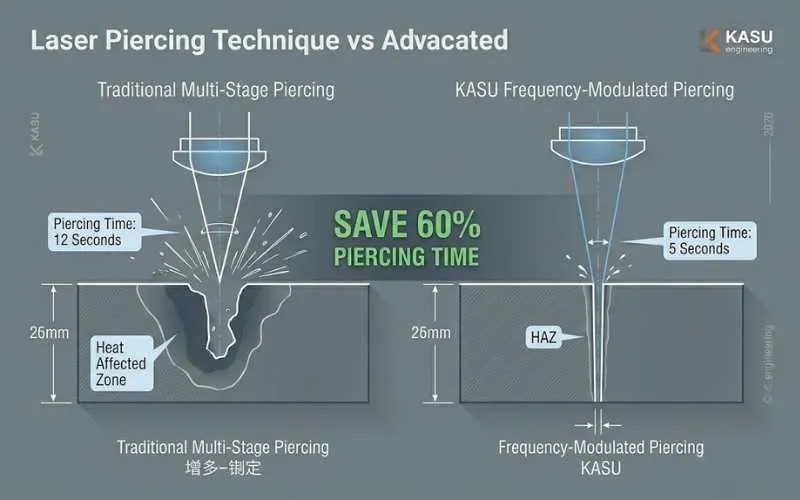
When cutting 20mm+ plates, the actual “cutting” is only half the battle. The Piercing Time is where most low-end machines fail.
If you are using a standard multi-stage pierce, a 25mm plate might take 10-15 seconds to penetrate. During this time, heat accumulates locally, often causing a “blow-out” that ruins the starting point of the cut. At KASU, we implement Frequency-Modulated Piercing. By pulsing the laser at specific intervals and varying the gas pressure dynamically, we reduce piercing time by up to 60%. For a distributor, this means your customer can process 15% more parts per shift—a massive selling point that has nothing to do with “wattage” and everything to do with software intelligence.
Critical Physics: Why Depth Degrades Edge Quality
As the laser penetrates deeper, it encounters physical barriers that every System Integrator must account for.
1. The Kerf Taper (The V-Shape Effect)
Laser beams are hourglass-shaped. For deep cuts, you need a Long Focal Length (7.5” – 10”). A common mistake I see is OEMs using a 5” lens for 20mm steel. The result is a significant “taper” where the bottom of the cut is narrower than the top. This fails American Welding Society (AWS) certified fit-ups.

2. Thermal Drift and Focal Shift
In high-power (12kW+) deep cutting, the protective window absorbs tiny fractions of energy. This creates a “Thermal Lens” effect, where the focal point physically shifts upward during the cut. Without Active Focal Compensation, your 30mm cut will start clean and end with heavy dross as the focus moves out of the optimal zone.
3. ISO 9013 Quality Classes at Depth
Deep cutting often pushes machines into lower quality classes. Distributors must manage expectations using the ISO 9013 standard for perpendicularity and angularity.
| Thickness (mm) | Class 1 (Precision) | Class 2 (Standard) | Class 3 (Rough) |
|---|---|---|---|
| 10mm | Range 0.12mm | Range 0.25mm | Range 0.50mm |
| 30mm | Range 0.35mm | Range 0.70mm | Range 1.40mm |
TCO Analysis: The “Air Cutting” Revolution
For B2B distributors, the most powerful sales tool is the Cost Per Inch. Traditionally, cutting 10mm stainless required high-pressure Nitrogen—expensive and logistics-heavy. However, with a 12kW+ KASU fiber laser system, you can switch to Ultra-High-Pressure Air Cutting.
- Savings: Eliminates the $15-$30/hour Nitrogen cost.
- Speed: Often 20-30% faster than Nitrogen at mid-range depths.
- Caveat: The edge will have a slight oxidation layer, acceptable for agricultural OEMs but not for medical-grade equipment.

Logistics and Safety: The Heavy Plate Reality
Cutting “deep” implies heavy raw materials. For distributors, this changes the machine specs:
- Bed Load Capacity: A 30mm steel plate weighs ~235kg per square meter. Ensure your OEM customers select a machine with a reinforced frame.
- Class 4 Safety: High-power deep cutting creates intense radiation and toxic fumes. Ensure the system meets CE/FDA laser safety Class 4 housing standards with high-volume dust extraction.

Solving the “Inconsistent Depth” Mystery
If your machine is underperforming, check these three “Red Flags”:
- Chiller Fluctuations: If water temperature varies by >±1°C, the wavelength shifts, reducing absorption in thick materials.
- Internal Beam Alignment: If the beam isn’t centered in the nozzle, gas flow becomes asymmetrical, causing “one-sided dross.”
- Material Grade: “Dirty” steel with high silicon will never cut as cleanly as Laser-Grade plate.
Engineering a Solution That Scales
Determining how deep a laser can cut is just the beginning. To build a sustainable operation, you need a partner who understands the nuances of piercing tech, thermal drift, and gas economics. At KASU, we specialize in high-precision vision laser cutters and heavy-duty industrial systems designed to meet the rigorous demands of global distributors.
Optimize Your Production Depth Today
Don’t settle for theoretical maximums. Our engineering team provides real-world data based on your specific material samples and regional power costs. We help you move beyond the “how deep” question to find the “how profitable” answer.
Request a Technical TCO Consultation with a KASU Engineer to determine the optimal KW-to-thickness ratio for your next project.