

What A Footwear Cutting Machine Replaces
Quick answer: A footwear cutting machine cuts shoe upper, lining and reinforcement parts from a digital pattern, replacing the clicking press and the per-size steel dies that traditionally gate every style and every size run.
Shoe factories are the extreme case of the tooling problem. A single style needs a die per component per size, so a modest range explodes into hundreds of dies that have to be made, stored, retrieved and eventually scrapped when the style ends. That die library is why sampling is slow and why small orders are unprofitable. Die-less cutting turns the pattern into a file: a size is a scale factor, a style revision is a re-nest, and a sample can be cut the afternoon the design lands. Laser adds a second capability that a knife does not have — it perforates and engraves the same panel in the same setup, which is how most decorative ventilation patterns are now made. Two boundaries are worth stating up front. PVC-based synthetic uppers release chlorine compounds under a CO2 beam and belong on a knife. And thick full-grain leather cuts but darkens at the edge, so whether laser suits your product depends on whether that edge is visible. Footwear material and performance testing standards are published by SATRA Technology.
Footwear Materials And How The Beam Handles Each
Four upper and lining families cover most shoe enquiries. The middle bullet is the one that changes the answer.

PU Synthetic Leather And Microfibre
- Formats: PU-coated and microfibre synthetic upper material, 0.8–2.0 mm, in rolls and hides.
- Watch out: PU cuts cleanly, PVC does not, and the two are visually indistinguishable on a sample board. A supplier substitution upstream can break a qualified process without anyone noticing until the fumes change.
- How we cut it: we ask for the material specification rather than the swatch and confirm the polymer before running. PVC-faced stock goes to a knife.

Engineering Mesh And Knitted Uppers
- Formats: sandwich mesh, spacer knit, flat-knit engineered uppers in polyester and polyamide.
- Watch out: engineered knit uppers are made to shape with the design knitted in — the cut has to follow the knitted line, not a nominal outline, and a blade will unravel the structure at the edge.
- How we cut it: camera registration reads the knitted or printed design and the beam fuses polyester filament ends at the cut, so the structure holds.

Genuine Leather And Suede
- Formats: full-grain, split and suede hides, 1.0–2.5 mm, for uppers, linings and trims.
- Watch out: leather cuts but the beam darkens the edge, and on light-coloured or unlined uppers that brown line is a visible reject even when the geometry is right.
- How we cut it: reduced power with high feed limits the darkening; we cut your actual hide and photograph the edge so you can judge it against your own standard.

Foam, Reinforcement And Insole Stock
- Formats: EVA and PU foam 2–10 mm, thermoplastic toe puff and counter stock, textile reinforcement tape.
- Watch out: reinforcement components are hidden parts, so they are the ones cut roughly — and a badly cut counter shows up as a fit complaint that nobody traces back to cutting.
- How we cut it: hidden components come off the same nested layout as the visible upper, so they get the same dimensional discipline. See our EVA foam page for foam-specific detail.
Footwear Components Cut Without Clicking Dies
The saving is in sampling speed, size range and style change — not in the cutting minute.

Upper Panels And Overlays
- Parts: vamps, quarters, tongues, eyestays, decorative overlays, in sizes 35–48.
- The hard part: every component needs a die in every size, so a fourteen-size range multiplies the die library by fourteen before a single pair is made.
- What you get: size grading is a file operation. The die library, its storage and its retrieval time disappear from the process.

Perforation And Decorative Patterns
- Parts: ventilation hole fields, brogue patterns, engraved logos and texture on upper panels.
- The hard part: with dies, perforation is a second tool and a second pass with its own registration problem, so pattern designs get simplified to what the tooling can do.
- What you get: perforation, engraving and outline in the same setup, so pattern complexity stops being a tooling decision.

Linings, Reinforcements And Insole Blanks
- Parts: lining panels, toe puffs, heel counters, insole boards, sock liners.
- The hard part: these are high-count, low-visibility parts, which is exactly why they are the last to be brought under dimensional control.
- What you get: hidden parts nested alongside visible ones from the same pattern file. See our shoe sole page for sole-specific work.

Sampling And Development Runs
- Parts: development samples, size-set builds, salesman samples, small custom orders.
- The hard part: a sample that waits on die making loses days per iteration, and in a market where ranges turn over seasonally those days are the whole competitive question.
- What you get: a sample cut the same day the pattern arrives, on the machine and parameters that will run the production order.
Recommended KASU Machines For Shoe Production
Choose by whether uppers carry a printed or knitted design that must be registered, and by throughput. All three run the same control software. The full range is on the KASU machine category page.

KX1814-S2 Double Head CCD Laser Cutter
- Cuts: printed and knitted uppers, mesh, PU synthetic leather.
- Specs: 1800×1400 mm class working area, CCD camera registration, two heads.
- Best for: patterned uppers where the cut must follow the design at a moderate machine cost.

KD1814-S2 Double Head Laser Cutter With Camera
- Cuts: flat-knit engineered uppers, printed overlays, perforated panels.
- Specs: 1800×1400 mm bed, top camera for higher-accuracy registration, double head.
- Best for: engineered knit uppers where the knitted design defines the cut line.

K1810-S4 Four Head Laser Cutting Machine
- Cuts: plain linings, reinforcements, insole blanks, foam components.
- Specs: four synchronised heads, 1800×1000 mm class zone, no camera.
- Best for: unpatterned high-volume components where throughput is the whole point.
A Laser Does Not Replace The Clicking Press — It Takes The Jobs It Handles Badly
A clicking press with a steel rule die is fast and cheap per pair once the die exists. That is still true. What it is bad at is the first fifty pairs, the revision, the perforation pattern and the sample room — which is precisely where a laser earns its place.
Distributors and OEM partners: KASU offers free OEM/ODM — custom models, your brand colours and logo, multilingual labelling, with no extra service charge. Details on About KASU.

Send Your Own Upper Material For A Free Sample Cut
- Send the PU microfibre, engineered mesh, leather or foam you actually run. We cut your panels and return them.
- Send a perforation pattern too — it is the job that decides the purchase more often than the outline is.
- Parameters recorded per material and shipped with the machine.
- For distributors: footwear development moves fast and dies are slow. Selling into the sample room first gets the machine in the building before the production argument even starts.

Which Upper Materials Should Not Go On A Laser
- PVC-coated synthetics are excluded — chlorine release damages the machine and is a hazard to the operator. PU synthetics are fine, and the two are sold side by side, so the base polymer has to come off the datasheet before the material reaches the machine. See PVC Cutting Systems.
- Genuine leather cuts cleanly but darkens at the edge to a degree that varies with tannage — a look some brands want and others reject. It is a sample question, not a spec question.
- Perforation and outline run in the same operation, which is what usually removes a second process step.
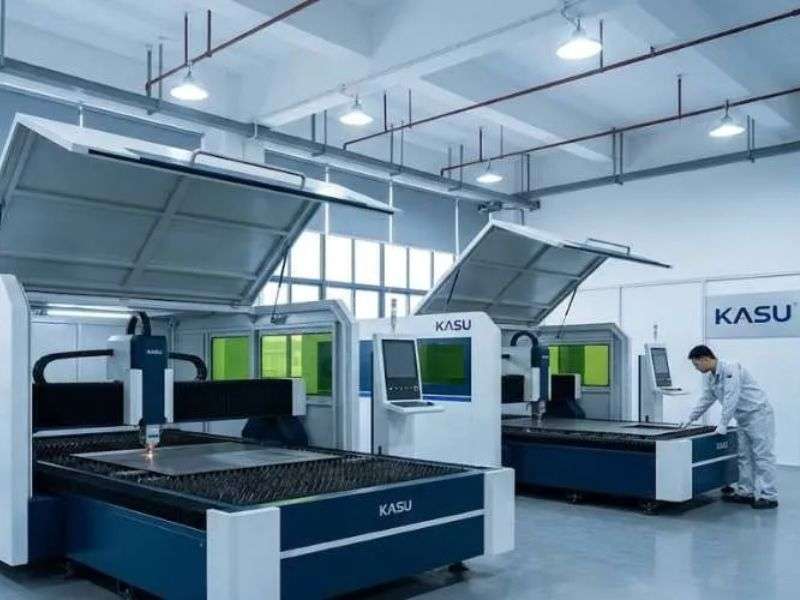
The Factory That Builds Your Footwear Cutter
- Founded 2009 · Shanghai R&D · 8,000+ m² Suzhou plant, 15 minutes from the R&D centre.
- 100+ models across 9 series, 70+ owned patents and software copyrights, China High-Tech Enterprise.
- Machines are built in-house rather than traded, so a parameter question reaches the people who built the motion system and specified the extraction.

CE And FDA Certified — Send Your Upper Material For A Free Sample Cut
- CE and FDA certified; 5,000+ customers across 80+ countries.
- Installation guidance, operator training and spare parts supplied from the factory that built the machine.
- Class-1 enclosed configurations available where the destination market requires them.
Buyer Questions On Cutting Shoe Uppers And Components
Does A Laser Replace The Clicking Press Entirely?
For uppers, linings, reinforcements and decorative work in synthetic, mesh, textile and foam, yes — those move to digital cutting and the die library for them disappears. Thick rubber and moulded sole components remain a press and mould operation. We usually recommend replacing the upper-room dies first, since that is where the die count is highest.
Can It Perforate Ventilation Patterns As Well As Cut Outlines?
Yes, and this is one of the main reasons shoe factories choose laser over a knife. Perforation, engraving and outline cutting happen in the same setup with the same registration, so a ventilation field does not need a separate tool or a second machine pass.
Will It Cut Genuine Leather Cleanly?
It cuts, but the beam darkens the edge because leather chars rather than melts. On lined or dark uppers that is usually acceptable; on light-coloured unlined uppers it is often a reject. We cut your actual hide and photograph the edge so the judgement is made on evidence rather than on a claim.
Which Upper Materials Should Not Go On A Laser?
Anything PVC-based. PVC releases chlorine compounds under a CO2 beam, which attacks extraction ducting and is a plant-safety issue rather than a quality one. Because PU and PVC synthetics look the same, we ask for the material specification before sample cutting.
How Fast Can We Get Development Samples?
Once the pattern is digitised, a sample set is typically cut the same day, because there is no tooling step between the file and the part. The practical limit is pattern preparation rather than machine time, which is why factories usually pair the machine with a CAD pattern workflow.
What Does A Footwear Cutting Machine Cost?
Cost depends on working area, camera type and head count rather than a list price. Send your upper materials, component mix, size range and daily pair output and we return a configuration with pricing. Sample cutting is free.
Related KASU Cutting Solutions
Three neighbouring pages covering the shoe components and materials most often quoted alongside upper cutting.


Technical Support for Footwear Cutting
Background on upper material screening, edge behaviour on leather and synthetics, and turning a component mix into a machine specification.


Get A Footwear Cutting Machine Quotation
Send your upper material specifications, component mix, size range and daily pair output. We confirm the polymer, run a free sample cut including any perforation pattern, and return the parameter record with the machine configuration.
Address: No. 105, Nanzhangjing Road, Taicang, Suzhou, Jiangsu, China
Email: [email protected]
WhatsApp: +86-18601718317