
A clear laser mark on denim is only useful if the fabric still holds up. A pale design can look successful straight off the machine, then turn brittle or tear after washing. The right target is the lightest mark that meets your appearance requirement and passes the same checks as the finished garment.
This guide focuses on indigo denim. It shows how to compare test marks, spot fiber damage and approve a repeatable production result. For other textiles, start with KASU’s general fabric engraving guide.
What makes a laser mark clear on denim?
On dark indigo denim, the laser can lighten the surface and create contrast with the surrounding blue cloth. The result depends on the dye, weave, garment finish and artwork. A broad shape may read well while fine lines disappear into the twill texture. Light or heavily washed denim may have too little contrast for the same design.
Judge the mark at the viewing distance of the finished product, under its normal lighting. Put the test beside an untreated piece from the same lot. A pale result is not proof that the yarns are undamaged; the laser’s heat can affect the cloth while changing its color.
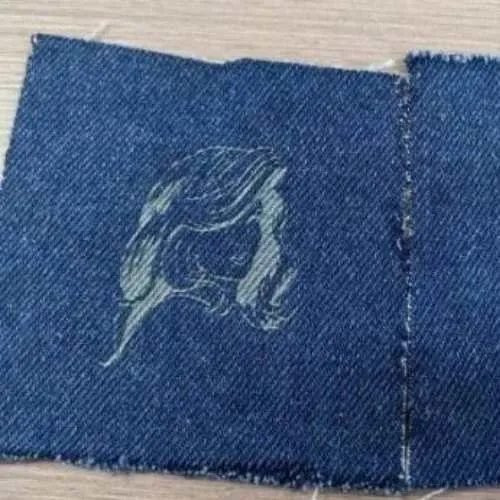
Why can a good-looking mark weaken the fabric?
More energy can increase fading while also damaging fibers. Energy changes with power, speed, resolution, focus and the number of passes. A dense filled design exposes more yarn than a thin outline. A setting that works on rigid denim may also be too harsh for stretch denim or a thinner section of a garment.
A peer-reviewed study of laser-engraved denim measured tear strength under different resolution and exposure settings. Its finding supports a practical rule: approve the visual effect and fabric performance together. Do not promise that any visible engraving leaves denim strength unchanged.
How should you find a usable engraving setting?
Make a small test matrix on denim from the production lot and choose the lowest exposure that gives a readable mark. There is no transferable power percentage: two machines set to the same percentage can deliver different energy to the fabric.
- Identify the denim. Record fiber content, weight, stretch content, dye and finish. Check any coating or backing before laser processing.
- Keep the surface flat. Secure the swatch without covering the test area. Folds, seams and pockets change focus and can make the mark uneven.
- Run a light-to-dark grid. Start from a conservative machine-approved profile. Change one variable at a time and include both a line and a small filled patch.
- Compare the back and the handle. Reject holes, reverse-side scorching, loose or brittle yarns, and any stiff patch. If more contrast requires those defects, revise the artwork or reject the process for that denim.
Keep a record of the laser, lens, focus, speed, power, resolution, passes and fabric lot. Re-test when the supplier changes the fabric or when the design moves across a seam. If the job also includes cutting denim parts, qualify the cutting operation separately; KASU’s denim laser cutting page covers that application.
What must pass before you approve production?
Approve the appearance only after checking the marked fabric in its intended use. Compare a marked swatch with an untreated control from the same lot. Wash both under the garment’s planned care conditions, then inspect the design and both faces of the cloth again.
| Check | Reject the sample if |
|---|---|
| Appearance | The design is unreadable, patchy or outside the approved color range. |
| Fabric condition | Yarns are broken, brittle, stiff or visibly damaged on the reverse side. |
| After washing | The marked area tears, changes beyond the approved appearance or feels weaker than the control. |
For a formal strength requirement, agree on the pass limit and a laboratory tear or tensile test before production. AATCC TM61 covers accelerated colorfastness to laundering. The tests answer different questions, so a good wash appearance does not replace a strength check.
Frequently asked questions
Does laser engraving remove only the indigo dye?
No. The visible effect is a lighter surface, but heat can also change or damage the yarns. Inspect and test the actual marked denim.
Can I use the same setting for every denim roll?
No. Dye, fabric weight, stretch content and finishing vary. Keep a reference profile, then confirm it on each production material and color.
Will a lighter mark always look better?
No. Stronger fading can demand more energy and increase the risk of fiber damage. Choose the lightest mark that meets the approved design.
Can stretch denim be laser engraved?
Only after testing its exact fiber blend and finish. Check the marked area for stiffness, melting and loss of stretch before approval.
Is a successful wash test enough to approve the fabric?
No. Washing checks appearance and use, while a separate strength test may be needed when the garment has a specified performance requirement.
For a production sample, send the denim specification, artwork, target appearance and care requirements. KASU can test a swatch and provide the marked result for your approval.