
The CO₂ laser tube is the one major part of a laser cutter that is designed to wear out. Sooner or later every glass-tube machine needs a new one, and a replacement goes much faster when you know the warning signs, order the right tube, and follow a safe sequence.
This guide covers how long a CO₂ laser tube lasts, how to tell when it is failing, what to specify when ordering, and the replacement steps.
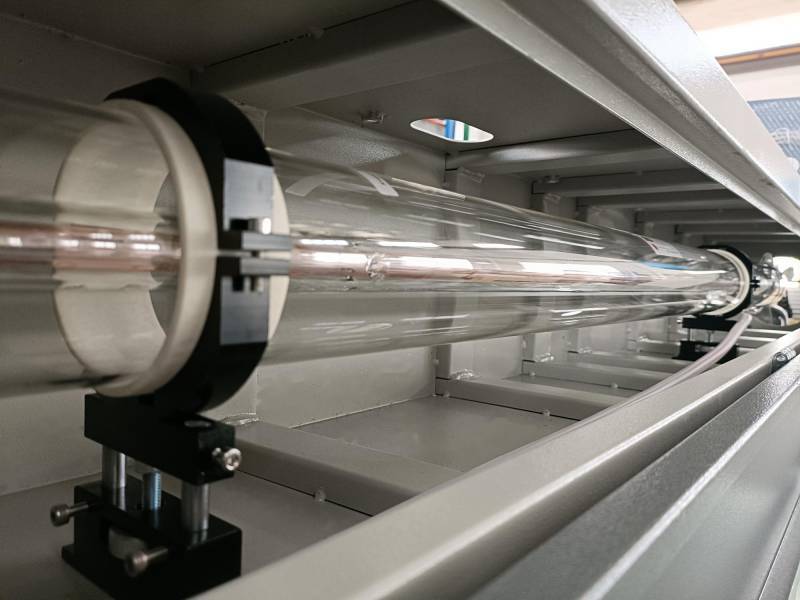
How Long Should a CO₂ Laser Tube Last?
A CO₂ laser produces its beam from a sealed gas mixture, and that mixture is what wears out. A glass CO₂ laser tube typically lasts about 6,000–10,000 hours of use, while an RF metal tube can run up to about 20,000 hours before it needs refilling or replacement. Glass tubes lose power gradually as the gas mixture inside breaks down, so “end of life” usually means the tube can no longer cut your thickest material at an acceptable speed, not that it stops completely.
Three habits shorten tube life more than anything else:
- Running near 100% power. Keeping everyday jobs at or below about 80% of rated power extends tube life.
- Poor cooling. Water that is too warm, too cold, dirty, or flowing weakly overheats the tube or cracks it. Keep the chiller clean and running whenever the tube fires.
- Long idle periods and cold storage. Tubes left unused for months, or allowed to freeze with water inside, often fail early.
How Do I Know if My CO₂ Laser Tube Is Bad?
The clearest sign is a steady loss of cutting power: jobs that used to cut in one pass now need higher power, slower speed, or a second pass. Rule out the cheaper causes first — dirty lens and mirrors, poor beam alignment, and wrong focus height produce the same symptom.
| Symptom | What it may mean | Check first |
|---|---|---|
| Cuts need more power or a second pass | Tube output declining with age | Clean optics, re-check alignment and focus |
| Glow inside the tube turns white or pink instead of its usual purple | Gas mixture degrading | Compare with the tube’s color when new |
| Output flickers or cuts become inconsistent | Tube or power supply problem | Have the power supply and wiring checked |
| Arcing or crackling near the high-voltage end | Insulation or connection failure | Stop immediately; inspect the high-voltage connection |
| No output at all | Cracked tube, failed power supply, or interlock | Check interlocks, water flow, and the tube for cracks |
| Water inside the tube’s gas chamber or cracks in the glass | Physical damage | Replace the tube; do not fire it |
What to Specify When Ordering a Replacement Tube
Order by wattage, physical length, and outer diameter, and confirm the tube matches your power supply. A tube that is too long will not fit the housing, and a tube rated above what the power supply can drive will not reach its rated output.
- Machine model and serial number
- Tube wattage and physical length (measured end to end)
- Outer diameter and mounting position
- Power supply model and rating
Glass tubes are fragile to ship. Consolidating spare tubes with a machine shipment is usually gentler on them than sending them alone. See the consumables KASU ships with each machine on our standard accessories and components page.
How to Replace a CO₂ Laser Tube: Step by Step
The job is mostly careful handling and water management: power down, drain, swap, refill without air bubbles, then re-align the mirrors. Follow your machine’s manual where it differs from the general steps below.

- Power off and wait. Switch off and unplug the machine and let the laser power supply discharge before touching the high-voltage wire. It carries tens of kilovolts when running.
- Drain the cooling water. Turn off the chiller and disconnect the water hoses from the tube, keeping the ends raised to limit spills.
- Disconnect the wires. Remove the high-voltage lead and the return (ground) lead, noting which end each connects to.
- Remove the old tube. Loosen the mounts and lift the tube out level, supporting both ends; never lift it by the hoses or wires.
- Fit the new tube. Place it in the mounts with the output window facing the first mirror, and tighten the mounts evenly without stressing the glass.
- Reconnect wires and insulate. Connect the high-voltage lead securely and insulate the joint as the manual specifies (typically with silicone or an insulating sleeve).
- Refill and purge air. Reconnect the hoses in the direction your manual shows, run the chiller, and check that the tube is completely full with no air bubbles before firing.
- Re-align the beam. Test-fire at low power and align the first, second, and third mirrors, then check focus with a test cut.

If you are not trained to work around high-voltage equipment, have a qualified technician or your supplier’s support team do the replacement. For routine care between tube changes, see how to maintain a fabric laser cutter.
Frequently Asked Questions
How long does a CO₂ laser tube last?
A glass CO₂ tube typically lasts about 6,000–10,000 hours of use; an RF metal tube can run up to about 20,000 hours. Running below about 80% power and keeping the cooling water clean and stable extends tube life.
How do I know if my CO₂ laser tube needs replacing?
Cuts that need noticeably more power or extra passes, a change in the glow color inside the tube, and flickering output are the usual signs. Clean the optics and check alignment first, because they cause the same symptoms.
Can I put a higher-wattage tube in my laser cutter?
Only if the tube fits the housing and the power supply is rated for it. A higher-wattage tube is usually longer, and an under-rated power supply will not drive it to full output.
Is there a 100W CO₂ laser tube available?
Yes. Glass CO₂ tubes are made in a range of wattages, commonly from about 40 W to 150 W and above; KASU machines use sealed glass tubes from 40 W to 200 W depending on the model.
Can I replace a CO₂ laser tube myself?
Many operators do, following the manual. The steps are simple, but the power supply produces very high voltage, so anyone not trained for high-voltage work should leave it to a technician.