
Quick answer
Verified EVA foam can often be cut with a CO₂ laser, and some laser facilities list EVA among approved materials. That does not make every foam sheet automatically safe. Confirm the product is EVA, obtain the SDS, identify pigments, flame retardants, adhesives and facing layers, and follow the machine and facility policy. Use extraction and monitor the test because EVA can smoke, melt and ignite.
EVA is not PVC, but identification still matters
EVA means ethylene-vinyl acetate. The word “vinyl” in the name does not mean it is PVC. However, suppliers may use loose product names, and a laminated sheet may combine EVA with adhesive, fabric or another polymer. The complete construction must be approved.
SAIC includes EVA foam on its approved materials list, while other facilities prohibit all foam. Policies differ because machines, filters and risk assessments differ. Use the strictest applicable requirement for your site.

Before you put EVA foam in a laser
- Obtain the product name, grade, density and thickness.
- Review the current SDS and technical data sheet.
- Confirm the foam is EVA and contains no PVC layer.
- Identify adhesive, release liner, coating and fabric layers.
- Confirm the machine manufacturer and facility permit the material.
- Check extraction and fire controls.
- Test the smallest practical sample while the operator remains present.
What result should you expect?
An approved EVA grade can produce detailed shapes and a lightly melted edge. Quality changes with density, thickness, color, additives, focus, power, speed and air movement. Too much energy can widen the kerf, round the edge or create more residue without improving the bottom of the cut.
Thicker foam is more likely to show taper. If the application requires a square, compressible sealing edge, compare the result with an oscillating knife.
Create a settings test grid
Do not publish one universal setting. Use a small grid that varies speed and power within a conservative range approved for the machine. Record:
- EVA supplier and grade.
- Density, thickness and color.
- Machine model and rated source power.
- Focus position and lens.
- Speed, power, passes and air assist.
- Exhaust configuration.
- Kerf, taper, residue and edge hardness.
- Whether the part passed the application requirement.
Common EVA cutting problems
The edge is too wide or rounded
Reduce unnecessary heat input, confirm focus and compare a faster pass with the current setting. Check whether the density or formulation changed.
The bottom does not separate cleanly
Confirm flatness and focus, then test a controlled second pass. A thick sheet may be better suited to a knife.
Small parts move
Reduce disruptive airflow where safe, improve hold-down and change the cut order so internal features run before the outer contour.
Smoke or residue increases
Stop and confirm the material batch and extraction. Do not assume every sheet sold as craft foam has the same formulation.
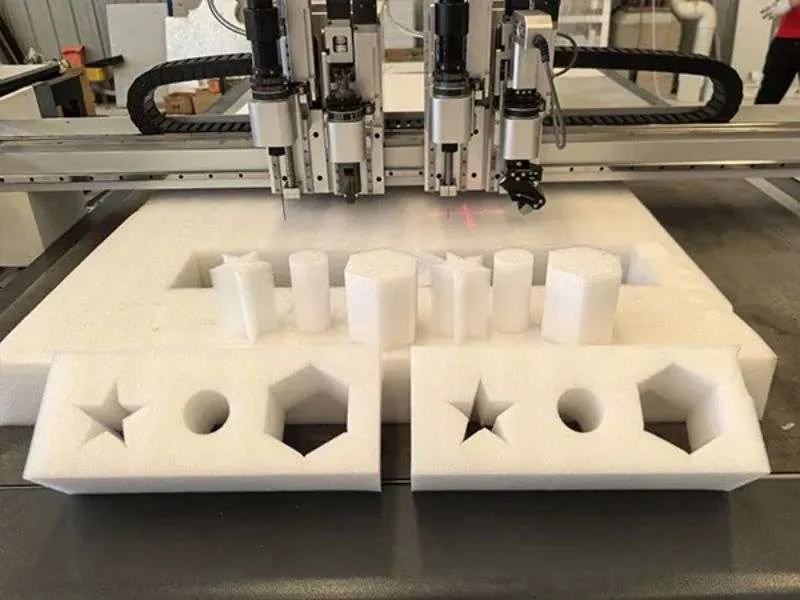
Laser, knife or die for EVA?
| Process | Best fit | Limitation |
|---|---|---|
| CO₂ laser | Approved EVA, detailed shapes, frequent design changes | Thermal edge, fumes and taper on thick foam |
| Oscillating knife | Thick foam and square, unmelted edges | Blade wear and minimum feature limits |
| Die cutting | Stable high-volume shapes | Tooling cost and slower design changes |
EVA applications
Common applications include packaging inserts, footwear layers, gaskets, sports padding, cosplay parts and protective components. The process decision depends on edge feel, compression, detail and production volume.
For approved EVA work, review the EVA foam laser cutter and foam packaging insert machine. Send KASU the SDS and a physical sample before selecting a machine or production setting.
Frequently asked questions
Is EVA foam toxic when laser cut?
Any thermal process can create irritating or hazardous fumes depending on formulation. Use the SDS, appropriate extraction and a site-specific risk assessment. “No PVC” does not mean “no fumes.”
Can a diode laser cut EVA foam?
Performance depends strongly on wavelength, power and foam color. KASU should keep this page focused on tested CO₂ workflows unless it has documented diode results.
How thick can EVA foam be laser cut?
There is no universal thickness. Density, focus, power, quality requirements and acceptable taper determine the practical limit. Test the exact grade.
Is laser cutting better than knife cutting for EVA?
Laser cutting is useful for approved thin-to-medium foam and fine detail. Knife cutting is often better for thick foam or a square, unmelted edge.