

What An Awning Cutting Machine Has To Get Right
Quick answer: An awning cutting machine cuts shade and awning fabric into seam-ready panels, valances and shaped trims from a digital layout, keeping stripe and pattern alignment across panels that will be sewn together.
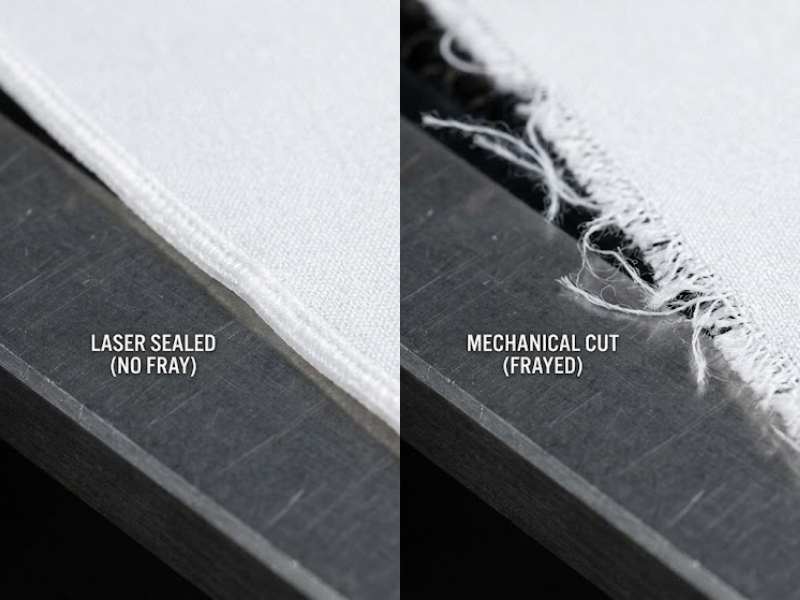
The defining problem in this trade is not the cut, it is the stripe. Awning fabric is usually woven with a stripe or a pattern that runs down the roll, and a finished awning is several panels seamed side by side. If the panels are not cut in the same phase of the pattern, the stripe steps at every seam and the customer sees it from the pavement. Cutting to nominal coordinates cannot solve that because the woven pattern drifts along the roll. Camera registration reads the pattern where it actually is, panel by panel, which is why the trade moved to digital cutting from hand marking and shears. The second gain is the edge: on polyester and PU-coated polyester the beam fuses the filament ends, so a valance scallop does not fray while it waits to be hemmed. The critical boundary is material. Solution-dyed acrylic and PU-coated polyester are laser work; PVC-coated awning cloth is not, because chlorine release is a plant-safety and duct-corrosion issue. Since both are sold as awning fabric and look similar on a sample card, we ask for the specification. Industry background is maintained by the Industrial Fabrics Association International.
Awning Fabrics And How Each Cuts
Four shade-fabric families cover most enquiries. The middle bullet is what decides beam versus blade.

Solution-Dyed Acrylic Canvas
- Formats: 250–340 gsm solution-dyed acrylic in 120–200 cm roll widths, plain and striped.
- Watch out: acrylic is the premium awning cloth and it is almost always striped or patterned, so the cut has to be phase-correct against the weave, not just dimensionally correct.
- How we cut it: camera registration on the woven stripe, panel by panel, so every seam in the finished awning lands in the same phase of the pattern.

PU-Coated Polyester
- Formats: 200–400 gsm PU-coated polyester for retractable awnings, canopies and covers.
- Watch out: PU and PVC coated cloth are sold side by side under the same product names, and only the specification tells them apart — loading the wrong roll is how a shop finds out its extraction is corroding.
- How we cut it: polymer confirmed from the specification before cutting; PU cuts with the polyester filament ends fused so panels reach the sewing bench stable.

Shade Mesh And Sail Cloth
- Formats: HDPE and polyester shade mesh 180–340 gsm for shade sails, pergola covers and screens.
- Watch out: mesh unravels from any mechanically cut edge, and on a tensioned shade sail an unravelling edge propagates under load rather than staying put.
- How we cut it: the beam fuses the monofilament ends at the cut, so the mesh keeps its structure right up to the edge without a separate sealing pass.

PVC-Coated Awning Cloth
- Formats: PVC-coated polyester awning and canopy cloth, still widely used for commercial and industrial canopies.
- Watch out: PVC releases chlorine compounds under a CO2 beam. It corrodes extraction ducting and is a plant-safety question rather than something to manage with more airflow.
- How we cut it: we do not. PVC-coated cloth belongs on a knife or hot-blade system, and if it is most of your volume we will tell you that before quoting. See our coated fabric page.
Awning And Shade Products Cut Seam-Ready
Each case below is a workroom trying to keep pattern alignment and edge stability through to the sewing bench.

Retractable And Fixed Awning Panels
- Parts: body panels for folding-arm, drop-arm and fixed frame awnings, with seam allowance built in.
- The hard part: panels are seamed side by side and any stripe phase error shows as a step at every seam, visible from street level for the life of the awning.
- What you get: phase-correct panels registered to the weave, so the seams align without the cutter marking by hand.

Valances, Scallops And Lettering
- Parts: scalloped and shaped valances, cut lettering, applied graphics and trims.
- The hard part: scallops are cut by hand against a template in most workrooms, and small inconsistencies read as sloppiness along a long horizontal edge.
- What you get: identical scallops from the file with the edge fused, plus cut lettering from the same layout as the panels.

Shade Sails And Pergola Covers
- Parts: triangular and quadrilateral shade sails, tensioned mesh covers, edge reinforcement patches.
- The hard part: sails are tensioned in service, so an unravelling mesh edge does not stay a cosmetic problem — it propagates under load.
- What you get: fused mesh edges and reinforcement patches nested with the sail from one layout.

Covers, Canopies And Replacement Panels
- Parts: replacement covers, boat and patio canopies, custom-size one-off panels.
- The hard part: replacement work is quantity one against a measured site drawing, which is exactly the job hand-cutting handles worst and tooling cannot serve at all.
- What you get: a one-off panel cut from the site measurements at the same quality as series work.
Recommended KASU Machines For Shade Fabric
Choose by panel length and by whether the fabric carries a stripe that must be registered. All three run the same control software. The full range is on the KASU machine category page.

KD1830-SY Large Format Top Camera Flatbed Laser Cutting Machine
- Cuts: full-length awning panels, long valances, large shade sails.
- Specs: 1800×3000 mm class working area, top camera for stripe registration.
- Best for: long panels where the whole length must be cut in one setup and kept in stripe phase.

KD1822-SY Large Format Top Camera Flatbed Laser Cutting Machine
- Cuts: standard awning panels, valances, scallops, mesh sails.
- Specs: 1800×2200 mm class area, top camera, CO2 source.
- Best for: mixed workroom output where registration accuracy matters more than maximum length.

K1814-SY Roll-to-Roll Double Head Laser Cutting Machine
- Cuts: plain unpatterned shade cloth and mesh straight from the roll.
- Specs: 1800×1400 mm cutting zone, roll-to-roll transport, two heads.
- Best for: plain stock where continuous feeding beats sheet handling.
On A Striped Awning The Job Is Matching, Not Cutting
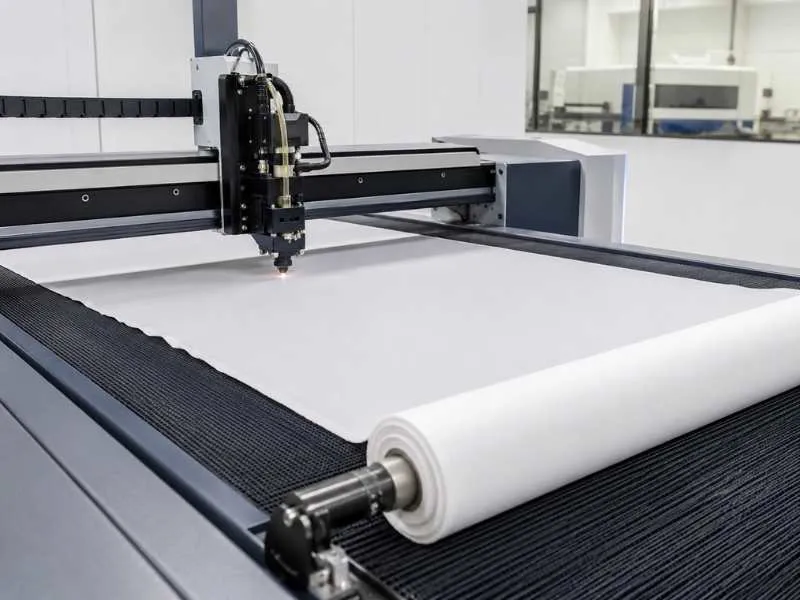
Solution-dyed acrylic canvas comes with a stripe pattern that has to run unbroken across seamed panels. The panels are cut separately and sewn together, so every panel has to be cut relative to where the stripe actually is on that roll — not where the nominal repeat says it should be.
Distributors and OEM partners: KASU offers free OEM/ODM — custom models, your brand colours and logo, multilingual labelling, with no extra service charge. Details on About KASU.

Send Your Own Canvas For A Free Sample Cut
- Send striped canvas if you run it. Plain cloth proves nothing about the job you are actually buying the machine for.
- We cut matched panels and return them so you can lay them together and check the seam line yourself.
- Parameters recorded per cloth and shipped with the machine.
- For distributors: awning shops are seasonal and replacement-driven. The valance, scallop and lettering work is what they currently outsource or do by hand — that is the wedge, not the main panels.

One Awning Cloth We Will Not Cut
- PVC-coated awning cloth is excluded from laser processing — those jobs go to a knife; see PVC Cutting Systems. Solution-dyed acrylic, PU-coated polyester and shade mesh are all fine.
- Shade mesh is an open structure — the beam passes between yarns, so backing and support matter more than power. The edge fuses as it cuts, which is what stops it unravelling.
- Long panels run in a single setup with conveyor feeding rather than being cut in sections and rejoined.
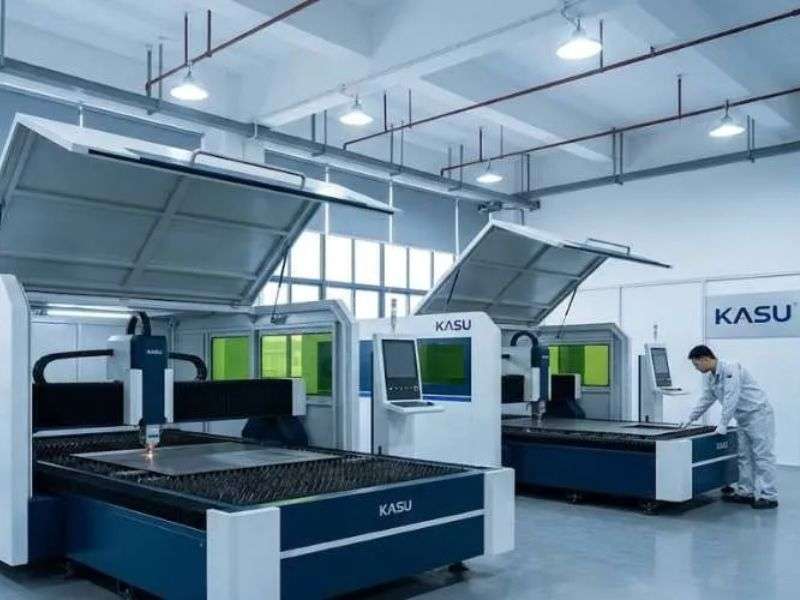
The Factory That Builds Your Awning Cutter
- Founded 2009 · Shanghai R&D · 8,000+ m² Suzhou plant, 15 minutes from the R&D centre.
- 100+ models across 9 series, 70+ owned patents and software copyrights, China High-Tech Enterprise.
- Machines are built in-house rather than traded, so a parameter question reaches the people who built the motion system and specified the extraction.
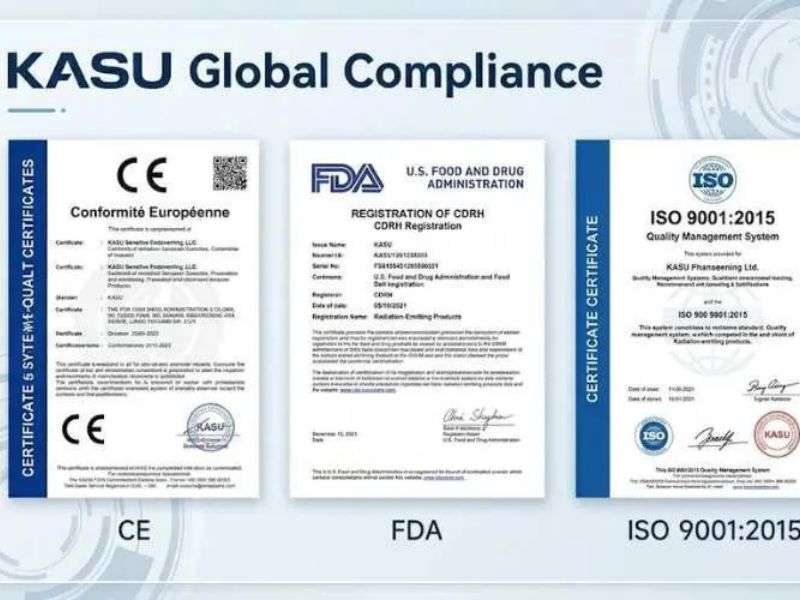
CE And FDA Certified — Send Your Canvas For A Free Sample Cut
- CE and FDA certified; 5,000+ customers across 80+ countries.
- Installation guidance, operator training and spare parts supplied from the factory that built the machine.
- Class-1 enclosed configurations available where the destination market requires them.
Buyer Questions On Cutting Shade And Canopy Fabric
Can It Keep Stripes Aligned Across Seamed Panels?
Yes — that is the main reason this trade uses camera cutting. The camera reads the woven stripe where it actually is on the roll rather than assuming a nominal position, and each panel is cut in the same phase of the pattern. Achievable alignment depends on stripe contrast and fabric stability, which we verify on your own cloth.
Can A Laser Cut PVC-coated Awning Fabric?
No. PVC releases chlorine compounds under a CO2 beam, which corrodes extraction ducting and raises a plant-safety issue. PU-coated polyester and solution-dyed acrylic cut well. Because both types are sold under similar product names, we ask for the material specification before sample cutting.
Does The Cut Edge Fray On Shade Mesh?
On polyester and HDPE mesh the beam fuses the monofilament ends as it cuts, so the mesh keeps its structure at the edge without a separate sealing pass. This matters more on shade sails than on awnings because a tensioned edge propagates damage under load rather than staying local.
How Long A Panel Can Be Cut In One Setup?
Up to a 1800 by 3000 mm class working area on the large-format models, which covers most awning panels and valances. Longer work is indexed rather than requiring a larger bed, and we size the machine against your usual panel mix rather than your largest occasional job.
What Does An Awning Cutting Machine Cost?
Price depends on working area, camera specification and feeding method rather than on a list figure. Send fabric types and gsm, typical panel sizes, whether stock is striped, and weekly output, and we return a configuration with pricing. Sample cutting is free.
Will It Cut Acrylic Canvas Cleanly?
Solution-dyed acrylic cuts well at moderate power. Acrylic fibre does not fuse the way polyester does, so the edge behaves differently and the hem allowance matters more. We cut your actual cloth and send the panel so your sewing operator can judge the edge before you buy.
Related KASU Cutting Solutions
Three neighbouring pages covering the coated and outdoor fabrics most often quoted alongside awning work.

Technical Support for Awning Fabric Cutting
Background on coated-fabric screening, edge behaviour on acrylic and polyester, and turning a workroom’s panel mix into a machine specification.

Get An Awning Cutting Machine Quotation
Send a striped sample of your own cloth, the coating specification, your usual panel sizes and weekly output. We register and cut your fabric free of charge and return the panel with the machine configuration.
Address: No. 105, Nanzhangjing Road, Taicang, Suzhou, Jiangsu, China
Email: [email protected]
WhatsApp: +86-18601718317